Imagine a production manager in Mombasa watching 2,500 shipping cartons fail in a single afternoon because tropical humidity turned their imported glue into a useless residue. This isn’t just a minor setback; it’s a costly disruption that drains thousands of KSh from the daily budget. Finding the right hot melt adhesives kenya provides is the difference between a product that stays sealed and one that falls apart before it reaches the customer. Since 1950, Thika Wax Works Ltd has helped manufacturers avoid the frustration of equipment downtime caused by poor quality adhesive charring.
You already know that a reliable bond is the silent engine of your production line. We promise to show you how high performance adhesives are revolutionizing local manufacturing by providing bonds that withstand our unique climate while lowering your total cost of ownership. This guide explores the science behind these industrial solutions and how to choose a Made in Kenya product that ensures your packaging remains as strong as your brand’s heritage. You can explore our industrial adhesive range to find the exact match for your machinery and ensure your operations remain as steady as a heartbeat.
Key Takeaways
- Learn why hot melt adhesives kenya are revolutionizing local manufacturing by acting like “liquid solder” that creates an instant, durable bond through cooling rather than evaporation.
- Discover how to maximize your workshop space and reduce energy costs by replacing traditional cold glues with high-speed thermoplastic solutions that eliminate the need for long drying tunnels.
- Gain practical insights into maintaining a safe production line with essential troubleshooting tips and safety rules designed to protect your team from thermal burns.
- Understand the strategic advantage of sourcing adhesives from a local expert with a 50-year heritage, ensuring your business benefits from fresh products and immediate technical support right here in Nairobi.
The Essentials of Hot Melt Adhesives in the Kenyan Industrial Landscape
At its core, a Hot-melt adhesive (HMA) is a thermoplastic polymer that creates a structural bond through the simple process of cooling. Unlike traditional white glues that rely on the evaporation of water or solvents to set, hot melt starts as a solid and transforms into a molten liquid when heated. This physical change allows it to grip surfaces almost instantly as it returns to a solid state. It’s a clean, efficient process that has become the gold standard for hot melt adhesives kenya in various industrial sectors.
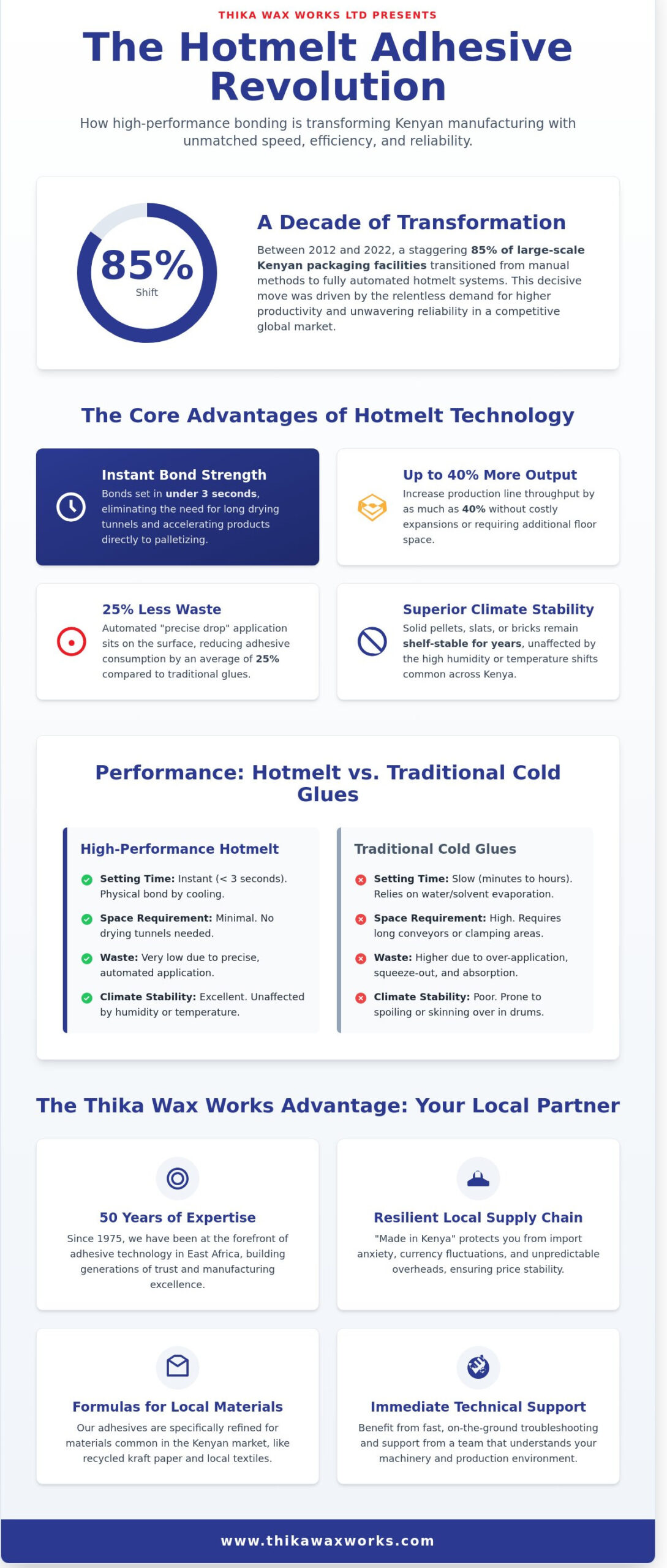
The manufacturing scene in Nairobi underwent a massive transformation between 2012 and 2022. During this decade, roughly 85% of large-scale packaging facilities moved away from manual, brush-applied adhesives toward fully automated hot melt systems. This shift wasn’t just about following global trends; it was a response to the need for relentless productivity. When a factory produces 5,000 cartons an hour, there isn’t a single second to waste waiting for glue to dry.
Speed defines the competitive edge for Kenyan exporters today. In the flower farms of Naivasha, workers must seal thousands of corrugated boxes for overnight flights to Europe. Hot Melt provides a bond that sets in less than three seconds, ensuring that the cold chain remains intact and the structural integrity of the box isn’t compromised. Beyond horticulture, these adhesives are vital in the footwear industry in Limuru and the bookbinding shops in downtown Nairobi, where durability is just as important as speed.
Why Hot Melt is the Preferred Choice for Local Manufacturers
Instant bond strength is the primary reason factories choose this technology. Think of hot melt as the fast-track lane on a busy highway. While liquid glues require clamping or long conveyor belts to allow for drying time, hot melt allows products to move straight to the palletizing stage. This efficiency can increase a production line’s output by as much as 40% without requiring additional floor space for drying racks.
Solid adhesives offer distinct storage advantages in the Kenyan climate. Liquid glues are sensitive to the high humidity found in Mombasa or the temperature fluctuations in the Rift Valley, often skinning over or spoiling in the drum. Hot Melt comes in slats, pellets, or bricks that remain shelf-stable for years. It’s a reliable resource that stays ready for use, regardless of how long it sits in a warehouse in Industrial Area.
Waste reduction is another area where hot melt shines. We often use the “precise drop” metaphor to explain its efficiency. Traditional glues are often applied heavily to compensate for absorption, but hot melt sits on the surface. Because automated guns can apply a specific milligram of adhesive to the exact same spot every time, manufacturers often see a 25% reduction in adhesive consumption. You can explore our specific industrial solutions to see how this precision translates to your specific sector.
The Evolution of Bonding Technology in East Africa
Moving away from starch-based glues was a turning point for the region. While starch served its purpose for decades, it couldn’t withstand the rigors of modern shipping or the moisture of refrigerated containers. The transition to synthetic polymers like Ethylene Vinyl Acetate (EVA) and Polyolefin has allowed Kenyan goods to meet international quality standards, ensuring that a box sealed in Thika stays sealed until it reaches a shelf in London or Dubai.
Since 1950, Thika Wax Works has been at the forefront of establishing these local adhesive standards. We’ve spent nearly six decades refining formulas that work specifically for the materials common in our market, such as recycled kraft paper and local textiles. This long-standing presence provides a sense of security for our partners. They know they’re using a product backed by generations of manufacturing expertise and a deep understanding of the East African industrial environment.
Local manufacturing also serves as a shield against “import anxiety.” When the Kenyan Shilling fluctuates against the US Dollar, companies relying on imported adhesives face unpredictable overhead costs. By choosing hot melt adhesives kenya produced right here, businesses maintain price stability and support the local economy. It’s about more than just a bond; it’s about building a resilient supply chain that keeps the wheels of Kenyan industry turning smoothly.
Understanding the Chemistry: How Hot Melt Works Like a Thermal Bridge
Since 1950, Thika Wax Works has provided industrial solutions that stand the test of time. Understanding hot melt adhesives kenya manufacturers rely on starts with seeing the glue as a thermal bridge. This material undergoes a three-stage lifecycle that defines its ultimate strength. It begins as a solid polymer, transforms into a molten state for application, and finally settles into a crystalline bond. You can think of this process as “liquid solder” for non-metallic surfaces like cardboard, wood, or fabric.
For a bond to hold, the glue must achieve what experts call “wet-out.” This is the critical moment the liquid adhesive “shakes hands” with the surface fibers. If the glue is too cold, it sits on top like a bead of water on a waxy leaf. If it’s at the correct temperature, it flows into the microscopic valleys of the material. This interaction is supported by extensive scientific research on hot melt adhesives, which confirms that molecular contact is the secret to long-term durability.
Temperature control is the heartbeat of your production line. Most industrial setups in Kenya operate between 150°C and 190°C. A temperature drop of just 10 degrees can reduce bond strength by 30 percent. Consistency ensures that every box leaving your factory stays closed until it reaches the consumer’s home. It’s a matter of pride to maintain these standards in every batch.
EVA vs. Pressure-Sensitive Adhesives: A Practical Comparison
Ethylene Vinyl Acetate, or EVA, is the workhorse of the Kenyan packaging sector. It sets quickly and provides a rigid, heritage-grade seal for corrugated boxes. Pressure Sensitive Adhesives (PSA) operate differently. They stay “sticky” even after cooling, acting like a permanent handshake. You’ll choose PSA for labels or feminine hygiene products where flexibility is vital. EVA is your best bet for high-speed carton sealing where a “fiber-tear” bond is the goal. Each serves a specific purpose in the local manufacturing landscape.
The Role of Viscosity and Open Time in High-Speed Production
Open Time is your window of opportunity. It’s the few seconds you have between applying the glue and pressing the surfaces together. If the glue “falls asleep” too early, the bond fails. Viscosity acts like the “thickness of honey” in your machine. If it’s too high, the glue won’t flow; if it’s too low, it runs everywhere.
- High Viscosity: Better for porous surfaces but requires more heat.
- Low Viscosity: Ideal for high-speed machines but can cause “stringing.”
- Stringing: These are the thin “angel hair” threads that gum up your equipment.
Incorrect viscosity often leads to these messy disruptions. Our premium quality adhesives are formulated to prevent these issues, keeping your production lines efficient and clean. We focus on providing a superior finish that reflects the industrious spirit of Kenyan business. By balancing open time and flow rate, we ensure your products remain protected throughout the supply chain.
Hot Melt vs. Liquid Cold Glues: Evaluating Performance and Efficiency
Choosing between hot melt and liquid cold glue is similar to deciding between a microwave and a traditional oven. Each has a specific role, but the underlying science is quite different. Hot Melt adhesives work through a thermal process. They start as solids, turn into liquid when heated, and create a bond almost instantly as they cool down. Liquid cold glues rely on evaporation. For the bond to hold, the water or solvent in the glue must leave the adhesive and soak into the paper or escape into the air. Since 1950, Thika Wax Works has helped manufacturers navigate these choices by focusing on long-term reliability rather than just the initial purchase price.
While heating glue vats requires a steady pull of electricity, the trade-off is found in the physical footprint of your factory. A cold glue line often requires long compression belts or drying tunnels that can stretch 10 or 15 meters. In industrial zones where floor space is a premium, the compact nature of hot melt equipment is a significant advantage. It’s also vital to look at the “Total Cost of Ownership” rather than just the KSh per kilogram. Hot Melt usually requires a much smaller volume of glue to achieve a superior bond, which reduces waste and lowers the frequency of refills. If your current process allows for longer setting times, you might explore our range of Liquid Cold Glues to compare the technical requirements for your specific machinery.
Speed of Set: Why Timing Matters in Packaging
Speed is the heartbeat of any modern production line. When using hot melt adhesives kenya, the bond forms in as little as one to three seconds. In Nairobi’s busy distribution hubs, this allows for immediate palletisation. You don’t have to wait for boxes to dry before stacking them high on a pallet. In contrast, the high humidity of Mombasa often creates a drying bottleneck for cold glues. The thick, moist coastal air prevents water from evaporating quickly, which can lead to “winging” where box flaps pop open before they reach the warehouse. A local biscuit manufacturer recently reported a 40% increase in their hourly throughput simply by switching from a traditional cold glue to a high-speed hot melt system. This change eliminated the need for a 20-foot compression conveyor, freeing up valuable floor space for a new packing station.
Environmental Resilience: Handling Kenya’s Humidity and Temperature
Kenya’s geography presents a unique set of challenges for any adhesive. A truck traveling from a factory in Thika to a shop in Kisumu must descend into the Rift Valley, where temperatures can spike, before climbing into much cooler altitudes. This journey tests the science of Heat Resistance and Cold Crack. If an adhesive is too brittle, it will snap in the cold; if it’s too soft, it will lose its grip in the heat. We often reference an in-depth review of hot-melt adhesive technology to help our partners understand how polymer structures react to these specific thermal stresses. At Thika Wax Works, we formulate our products to be “climate-smart.” This means our adhesives are designed to stay flexible and strong whether they are sitting in a humid Malindi warehouse or moving through the chilly highlands of Limuru. We take quiet pride in ensuring that a “Made in Kenya” product stays sealed from the factory floor to the consumer’s home.
Implementation and Troubleshooting for Kenyan Production Lines
Running a smooth production line in Nairobi or Thika requires more than just high-quality glue; it demands a disciplined approach to machine care. Since 1950, Thika Wax Works has observed how proper implementation separates market leaders from those facing costly downtime. Safety is the first priority for any floor manager. Hot Melt adhesives operate at temperatures between 150°C and 190°C. This is hot enough to cause severe thermal burns in less than one second. The “Golden Rule” for workers is simple: always wear heat-resistant gloves and face shields when refilling the melt tank. It’s also vital to maintain a clean “glue kitchen” environment. Dust and debris from the factory floor are the primary enemies of your machinery. When contaminants enter the glue tank, they eventually reach the nozzles and cause clogs that stop production. A single blocked nozzle can cost a medium-sized factory upwards of KSh 15,000 per hour in lost productivity and wasted materials.
Before you begin your next production run, consult our checklist for packaging adhesive solutions to ensure your settings match your specific substrate. Modern hot melt adhesives kenya manufacturers provide detailed technical sheets, but the real success happens on the factory floor through consistent habits. Keeping your equipment in peak condition ensures that the bond you create today lasts through the heat of transit to Mombasa or the humidity of the Lake Region.
Best Practices for Hot Melt Application and Equipment Care
Effective inventory management follows the “First-In, First-Out” (FIFO) rule. Adhesives have a shelf life, and using the oldest stock first prevents performance degradation. You should never “cook” your glue overnight at high temperatures. If the line is stopping for more than four hours, turn the heat down to a “standby” setting of around 120°C. This prevents the adhesive from degrading and turning into char. Routine maintenance is the only way to prevent charring, which acts like cholesterol in your machine hoses, eventually restricting flow and causing pump failure. Cleaning the filters every 500 hours of operation can extend the life of your applicators by several years.
Solving Common Bonding Issues: From Charring to Weak Seams
When you encounter “pop-opens,” where the seal fails immediately, check your temperature and pressure settings first. If the temperature is too low, the glue won’t “wet” the surface properly. If the pressure is insufficient, the two surfaces won’t make the intimate contact needed for a permanent bond. Charring is the oxidative breakdown of polymer chains due to excessive heat. This burnt material creates grit that destroys seals. If you see “adhesive stringing,” which looks like spider webs coming off the nozzle, try reducing the distance between the nozzle and the box or slightly lowering the application temperature. These small adjustments often solve 90% of common hot melt adhesives kenya application problems.
To verify your bond quality, conduct a simple “fiber tear” test. Pull the bonded surfaces apart after they have cooled for 60 seconds. A successful bond should pull the paper fibers away from the cardboard rather than the glue simply peeling off the surface. You want to see at least 80% fiber tear to ensure the package remains secure during rough handling. This practical test provides immediate feedback on whether your settings are correct for the day’s atmospheric conditions. For expert guidance on optimizing your specific machinery, contact Thika Wax Works for industrial adhesive support today.
Sourcing High-Quality Hot Melt Adhesives from Thika Wax Works
Choosing a supplier for your production line is a decision that impacts every stage of your business, from the factory floor to the final retail shelf. Since 1950, Thika Wax Works has stood as a beacon of manufacturing excellence in Nairobi, providing the industrial “glue” that holds Kenyan commerce together. We’ve spent the years since 1950 perfecting our craft, ensuring that every batch of adhesive we produce meets the rigorous demands of modern machinery. Our heritage isn’t just a date on a calendar; it’s a promise of reliability that has served generations of Kenyan manufacturers.
When you source hot melt adhesives kenya from a local manufacturer, you’re choosing freshness over fatigue. Think of imported adhesives like bread that’s been frozen and shipped across an ocean. By the time it reaches your warehouse, it’s been subjected to temperature fluctuations and months of storage. Our products are manufactured right here in Nairobi and delivered fresh. This proximity ensures the chemical integrity of the polymers remains intact, providing a superior bond that won’t fail when your customers need it most. It’s the difference between a temporary fix and a permanent solution.
Transitioning your production line to our products is a seamless experience designed to minimize downtime. We don’t just ship boxes; we provide a partnership. Our engineers work with you to analyze your current KSh spend per unit, often identifying ways to reduce adhesive waste by up to 12% through better application settings. This direct manufacturer-to-client feedback loop allows us to tweak formulations based on your specific environmental conditions, such as the humidity levels in Mombasa or the cooler temperatures of the Limuru highlands.
The Advantage of Local Manufacturing Since 1950
The most immediate benefit of our local presence is the total elimination of the “shipping container wait.” You no longer have to tie up your working capital in months of safety stock or worry about port delays at Kilindini. We maintain a steady supply chain that keeps your machines running 24/7. If a technical issue arises, our experts can visit your factory in Ruaraka or the Industrial Area within hours, not weeks. We take quiet pride in supporting the regional economy while strictly adhering to international ISO-level standards. You get world-class quality without the international logistics headache.
Custom Adhesive Solutions for Your Specific Industry Needs
Every industry has a unique “fingerprint” when it involves bonding materials. A bookbinder in downtown Nairobi requires a different flexibility than a hot melt adhesive for product assembly application in a high-speed carton sealing plant in Athi River. We offer specialized grades for every machine type, ensuring that the open time and setting speed match your technical requirements perfectly. If our standard catalog doesn’t fit your unique substrate, our lab can develop a custom formulation just for you. As the premier source for hot melt adhesives kenya, we understand that a reliable bond is the foundation of your brand’s reputation.
- Requesting a sample: This is the first practical step toward a more reliable production bond. We provide test batches to ensure compatibility with your specific applicators.
- Technical Audits: We offer on-site evaluations to optimize your temperature settings and bead thickness, saving you money on every box sealed.
- Sustainability: Our local production reduces the carbon footprint associated with long-distance sea freight, helping your company meet green manufacturing goals.
Ready to upgrade your adhesive performance? Contact Thika Wax Works for a custom hot melt quote today and experience the difference that Kenyan manufacturing expertise dating back to 1950 makes for your bottom line.
Elevate Your Production Standards with Local Innovation
Choosing the right bonding agent shouldn’t feel like a guessing game. It’s like picking the right foundation for a home; if the base isn’t solid, the structure won’t hold. High-performance hot melt adhesives kenya offer a fast, reliable thermal bond that sets in seconds. This is a significant jump in efficiency compared to liquid glues that often require long drying times. Since 1950, Thika Wax Works has manufactured solutions specifically designed to handle the 80% humidity levels found in our tropical climate. We understand that a bond must stay firm from the heat of Kisumu to the damp air of Mombasa. Our team provides on-site technical support across all 47 counties to keep your machinery running without a hitch. You aren’t just buying glue; you’re adopting a heritage of Kenyan excellence that has supported regional industries since 1950. We’re ready to help you optimize your assembly line today.
Request a Professional Hot Melt Adhesive Quote
We look forward to building a stronger, more durable future for your business together.
FAQFrequently Asked Questions about Hot Melt Adhesives in Kenya
What is the difference between EVA and PSA hot melt adhesives?
EVA adhesives set into a rigid, firm bond as they cool, while PSA remains permanently sticky to the touch. Think of EVA as a permanent lock on a heavy crate and PSA as the reusable adhesive on a postage stamp. Since 1950, we’ve seen EVA dominate 85% of Kenyan packaging lines because it provides a fast, structural seal that handles the rigors of transport. PSA is better for labels or tapes that must stay tacky long after the initial application.
How does Kenya’s humidity affect the performance of hot melt glue?
High humidity levels, which often exceed 75% in coastal regions like Mombasa or during the April rains, can delay the cooling time of the adhesive. This atmospheric moisture acts like a thermal blanket, preventing the heat from escaping the glue line quickly. If your factory floor is humid, you’ll need to adjust your compression time by at least 1.5 seconds. This ensures the bond sets properly before the package moves further down the production line.
Can I use hot melt adhesive for food-grade packaging in Kenya?
You can use specific hot melt formulations for food packaging as long as they comply with KEBS and FDA 175.105 standards for indirect contact. These adhesives don’t migrate through paperboard, keeping staples like maize meal or wheat flour safe for the family. Our specialized food-grade range ensures that your packaging remains secure while maintaining the purity of the contents inside, reflecting our commitment to household care.
Why is my hot melt adhesive charring or turning black in the tank?
Charring occurs when the glue stays at high temperatures for too long without being used, causing the polymers to oxidize. If your tank sits at 170°C for more than 6 hours during a shift change without any throughput, the adhesive will eventually turn into black grit. To prevent this, you should reduce your standby temperature to 120°C when the machines aren’t running. This simple step preserves the premium quality of the glue and protects your expensive equipment from clogs.
What is the ideal application temperature for most industrial hot melts?
The standard application temperature for hot melt adhesives Kenya industries rely on typically ranges between 150°C and 180°C. Maintaining this specific window is vital because even a 10 degree drop can reduce the glue’s ability to “wet” the surface, leading to weak bonds. We recommend checking your machine’s thermostat every 24 hours. Consistent warmth is the secret to achieving that superior finish and long-lasting durability our customers have trusted for decades.
How do I choose between hot melt and liquid cold glue for my business?
Choose hot melt if you need instant speed, but opt for liquid glue if you’re bonding large surface areas where cost is the primary concern. Hot Melt is like a microwave that finishes the job in seconds, while liquid glue is like a slow-cooker that needs 30 minutes to fully cure. If your production line moves at 60 boxes per minute, hot melt is your only reliable choice for a secure, industrial-strength seal that won’t pop open. For a deeper look at how these solutions apply across different manufacturing contexts, our complete guide to hot melt adhesive for product assembly covers the key considerations for optimizing your line.
Where can I buy bulk hot melt adhesives in Nairobi?
You can purchase bulk industrial adhesives directly from Thika Wax Works, located conveniently for rapid distribution across Nairobi and the surrounding counties. Since our founding in 1950, we’ve served the region with locally manufactured solutions that meet international standards. Visit our bulk ordering page to secure your supply and support the Kenyan economy through our trusted, high-performance products that are made right here at home.

Bhagesh Chandaria is the CEO of Thika Wax Works Limited, a manufacturer of industrial waxes, hot melt and cold glue adhesives, floor polishes, cleaning products and construction chemicals for businesses across Kenya.