
What if your assembly line could move 40% faster just by changing how you stick things together? Since the 1950s, Thika Wax Works Ltd has helped Kenyan manufacturers solve the daily headache of slow production. Most makers agree that waiting for liquid glue to dry is like watching a slow sunset when you still have miles to travel; it just holds everyone back. It wastes time. Messy workspaces and weak bonds in humidity become a thing of the past when you use the right hot melt adhesive for product assembly. This simple change turns sticky problems into a smooth, reliable process that works every single time.
In this guide, you’ll learn how these modern glues act like a firm, instant handshake between materials, creating a permanent hold in seconds rather than minutes. We promise to show you how to lower your waste costs and build professional products that reflect the excellence of Kenyan craftsmanship. We’ll also see how this fits into your wider packaging and woodworking needs. We will walk through the best tools for 2026 and help you find the right glue for your shop to keep your production line running at peak performance.
Key Takeaways
- Understand how hot melt adhesive for product assembly works like a melting wax candle to create a bond that holds tight the moment it cools.
- Learn how to use “Open Time” to your advantage, giving you the brief moment needed to position parts perfectly before the glue stays put.
- Compare hot melt to traditional cold glues to see how you can avoid messy spills and speed up your production line in the factory.
- Explore how this reliable glue is used across Kenya to build everything from sturdy furniture to secure food packaging.
- Discover why working with a local leader like Thika Wax Works ensures you get the heritage and technical support your business deserves.
What is Hot Melt Adhesive for Product Assembly?
At its heart, a hot melt is a solid glue that turns into a liquid when you heat it up. Think about a wax candle on a dinner table. When you light the wick, the hard wax melts into a clear liquid that flows easily. Once you blow out the flame, that liquid turns back into a solid. A Hot-melt adhesive works just like that. It provides a strong, instant bond that helps businesses build everything from shoe soles to cardboard boxes.
When we talk about “product assembly,” we’re simply talking about the process of putting different parts together to create a finished item. Whether it’s a furniture maker in a bustling city or a packaging plant in an industrial zone, using a high-quality hot melt adhesive for product assembly ensures that the final product stays together through heat, cold, and rough handling. Since the 1950s, we’ve seen how choosing the right materials from a trusted industrial adhesive manufacturer can make or break a business’s reputation.
To better understand this concept, watch this helpful video:
The Simple Science: From Solid to Liquid
Heat is the key that “wakes up” the glue. When the adhesive is hot, it flows into the tiny, invisible gaps on the surface of the materials you’re joining. This creates a deep grip that holds tight once the glue cools down. It’s a much cleaner process than using old-fashioned glues that rely on harsh chemicals or smelly solvents. You don’t have to worry about breathing in dangerous fumes in your workshop. Hot melt is 100% solids content, which means it has no water to evaporate and won’t shrink as it dries.
Why Manufacturers are Making the Switch
Many local workshops are moving away from slow, manual gluing methods. In the past, workers had to wait hours for liquid glue to dry. Today, automated assembly lines use a specific hot melt adhesive for product assembly to bond parts in less than three seconds. This speed helps businesses produce more items every day without losing quality. A factory that once produced 500 units a day can often double its output just by switching to a faster-setting glue.
Buying locally sourced solutions also solves many supply chain headaches. Instead of waiting weeks for a shipment to arrive at a distant port, manufacturers can get fresh supplies directly from a trusted provider like Thika Wax Works Ltd. This reliability helps local companies meet international quality standards and keep their promises to customers. It’s about more than just glue; it’s about supporting the industrious spirit of local enterprises and ensuring every household product is built to last.
How Hot Melt Adhesives Work in Your Factory
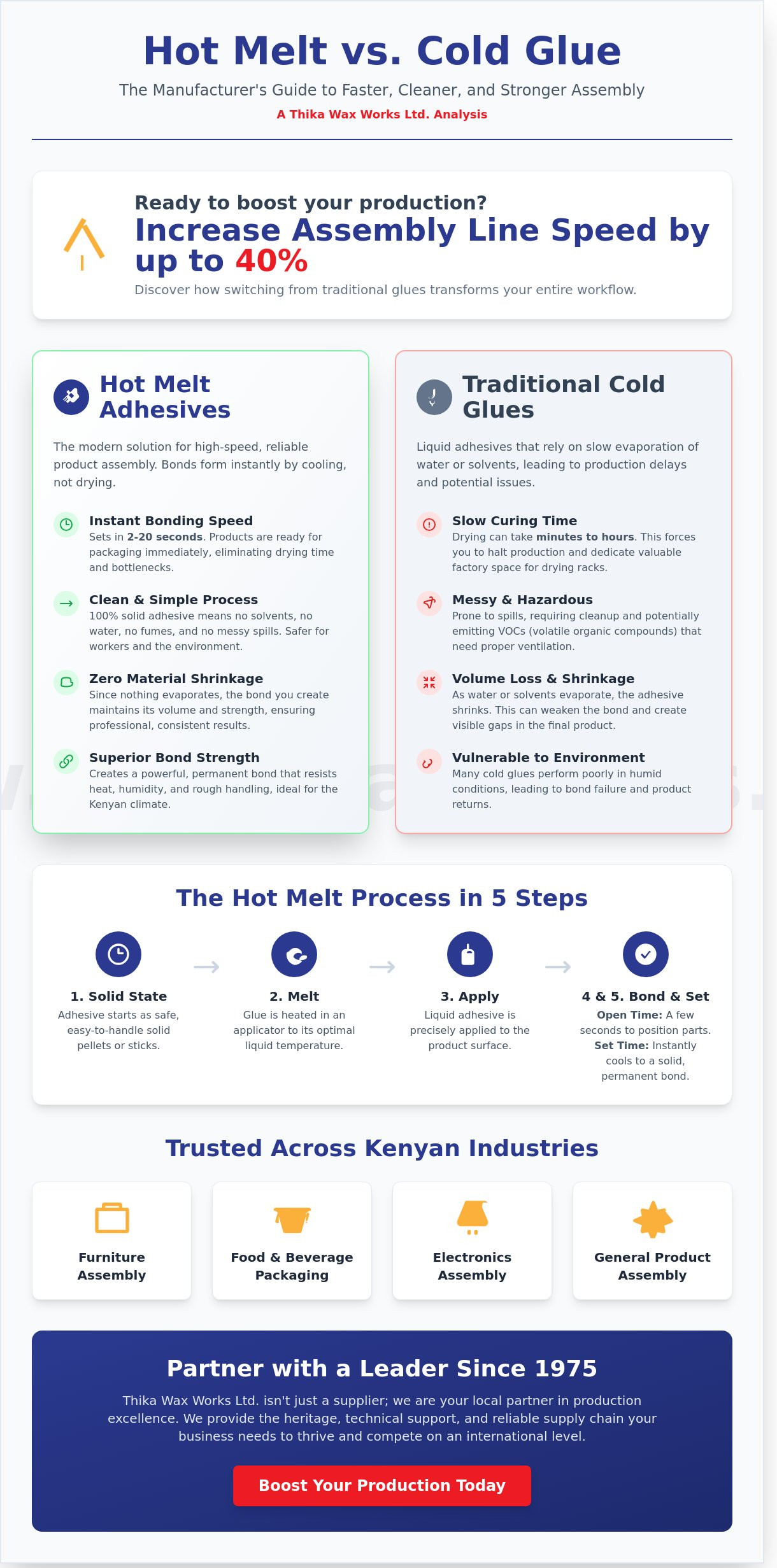
The process starts at the glue pot. Solid pieces of adhesive sit waiting until your machine reaches the correct melting temperature. Once the heat turns the solid into a liquid, it flows through a heated hose to the nozzle. When the liquid hits your product surface, a countdown begins. We call this the Open Time. It’s a short window, often lasting between 5 and 20 seconds, where the glue is still wet enough for you to move parts or align edges perfectly.
Immediately after the Open Time, the Set Time takes over. This is the moment the glue hardens into a permanent bond. Unlike traditional glues that need to evaporate water or chemicals to dry, hot melt works by cooling down. This means you don’t need long drying racks or massive storage areas to hold items while they dry. Your products can move from the assembly station straight into a shipping box. Using a hot melt adhesive for product assembly allows your factory to keep moving without hitting the brakes for a drying cycle.
The Cooling Magic: Instant Bonding
Think of the adhesive as a liquid bridge that turns into solid rock the moment it touches a cool surface. This “cooling magic” is why hot melt is the gold standard for high-speed production lines in Kenya. If your line produces 50 units every minute, you need a bond that stays put instantly. Recent innovations in hot melt adhesives have made these bonds even more reliable for complex tasks like electronics assembly. At Thika Wax Works, we’ve refined our formulas since the 1950s to ensure they handle the Kenyan climate. Whether your factory is in the humid heat of Mombasa or the cool highlands of Eldoret, the bond remains steadfast and won’t fail when temperatures shift.
Choosing the Right Shape: Pellets, Sticks, and Blocks
The glue comes in different shapes to match the way you work. Pellets are small beads that are perfect for large, automated machines. They melt quickly and are easy to pour into industrial melting tanks. If your team does manual assembly, glue sticks are the better choice for hand-held glue guns. We also offer blocks for heavy-duty melting systems used in packaging. Since the 1950s, we’ve focused on creating shapes that prevent machine clogs and keep your production running smoothly. Choosing the right form ensures your equipment lasts longer and your workers stay productive. You can find the best fit for your machinery by looking at our hot melt adhesive products designed for local industrial needs.
Hot Melt vs. Liquid Cold Glues: Which One Wins?
Choosing the right glue is about more than just sticking two pieces together. It’s about how your workshop runs every single day. Since the 1950s, Thika Wax Works has seen how the right choice can help a business grow or hold it back. Many people start their journey with liquid cold glues because they’re a traditional choice. They’re reliable for many tasks, but they have a major weakness: they’re slow. When you’re looking for the best hot melt adhesive for product assembly, you’re usually looking for a way to beat the clock. Liquid glues need time for the water to evaporate before they hold tight. Hot melt works by cooling down, which happens almost the moment it touches the surface.
Speed and Efficiency: The Race to the Finish Line
Think about the difference between a bicycle and a car. A bicycle is a fine way to get around, but a car gets you across town in a fraction of the time. Liquid glue is like that bicycle. It works, but you’re at the mercy of the air around you. In humid parts of Kenya, liquid glue can take a long time to set. This slows down your entire production line. Hot melt is the car. Because it bonds in seconds, your team can move from one item to the next without stopping. This speed means you can often finish 30 percent more products in a single shift. It also means you don’t need massive tables to hold wet products while they dry. Your floor stays clear, and your “work-in-progress” inventory doesn’t pile up and get in the way.
Storage and Waste: Keeping Your Workspace Clean
In a busy factory or workshop, cleanliness is a sign of a job well done. Liquid glues can be a bit of a headache to manage. They can spill, soak into paper parts, or grow a thick skin on top if the lid isn’t tight. If they’re stored in a place that gets too cold, they can even freeze and become useless. Hot melt is much more steadfast. It stays in a solid form until you’re ready to use it. This gives it a much longer shelf life, so you don’t have to worry about your investment going to waste.
When you apply hot melt, you use a precise nozzle. This means you get exactly the amount you need with no messy drips to ruin the premium quality of your work. It’s a cleaner process that keeps your products looking professional. To keep your tools and floors in top shape, using the right cleaning products is a smart way to maintain your equipment. We take great pride in providing these solutions to help Kenyan manufacturers stay productive and organized. It’s all part of our commitment to excellence that started decades ago.
Common Uses: From Furniture to Food Boxes
Thika Wax Works has been a trusted partner for Kenyan manufacturers since the 1950s. We know that a product is only as good as the bond that holds it together. Using a reliable hot melt adhesive for product assembly acts like an invisible backbone for your goods. It ensures that everything from a simple carton of milk to a heavy wooden cupboard stays solid and safe. This glue is not just for factories; it is a tool that brings industrial strength into everyday items we use at home.
In the world of “End-of-Line” packaging, hot melt is the gold standard for sealing boxes. Think of it as a strong, permanent hug for your shipping containers. When a box travels hundreds of kilometers on bumpy roads, the seal must not fail. Hot melt handles different surfaces like recycled paper or shiny cardboard with ease. It is also a key ingredient in making retail displays look sharp. These displays need to stand tall in a supermarket for weeks without sagging or peeling apart.
For those making laundry and kitchen supplies, the packaging must be tough. It has to protect soaps and powders from moisture and heat. Our adhesives provide a shield that keeps these household essentials fresh and ready for use. This commitment to quality has been our heritage for over 60 years.
Building Better Packaging and Displays
A strong box seal is vital for protecting goods during transport. In a busy warehouse, a hot melt adhesive for product assembly sets in less than 2 seconds. This speed allows machines to pack thousands of items per hour. Whether the surface is rough paper or smooth plastic, the glue bites deep to create a tear-resistant bond. This keeps your products safe from the factory floor to the customer’s door.
Assembly in Automotive and Textile Industries
Inside a car, hot melt bonds foam, fabric, and plastic panels together. These bonds are built to last. They must survive vibrations and temperatures that hit 70 degrees Celsius under the Kenyan sun. In the textile world, we use “pressure sensitive” glues for labels. These work like a high-tech sticker that stays put but doesn’t ruin the fabric. It is a clean and efficient way to handle branding and trim assembly without the mess of old-fashioned glues.
Furniture makers also find great value in these adhesives. Bonding wood joints or attaching fabric to a chair frame becomes much faster with hot melt. Because it dries almost instantly, a workshop can increase its daily output by 20% compared to using liquid glues that take hours to dry. It is a simple way to boost work and maintain the high standards that Thika Wax Works stands for.
Are you looking for a bond that lasts? View our premium hot melt adhesives to find the perfect fit for your business.
Choosing a Trusted Partner for Your Adhesives
Finding the right partner for your factory is like choosing a sturdy foundation for a house. You need someone who will stand by you when things get tough. Since the 1950s, Thika Wax Works has been that steady hand for businesses across Kenya. We don’t just sell a product; we share over 60 years of manufacturing wisdom. Choosing a local partner means you get help that’s just a phone call or a short drive away. This local touch ensures your production line never has to wait for a technician to fly in from another continent.
Consistency is the heartbeat of a successful factory. If your glue changes from one week to the next, your whole assembly line can grind to a halt. We treat our quality control like a sacred promise. Every batch of hot melt adhesive for product assembly that leaves our facility is tested to make sure it sticks exactly the way it should. This gives you peace of mind, knowing your products will stay together long after they leave your warehouse. You can learn more about our commitment to excellence on our about us page.
Working with a manufacturer based right here in Kenya offers more than just fast shipping. It means your glue is designed for our specific environment. We understand the dusty roads and the humid air that can affect how a seal holds. Our experts are ready to help you solve problems before they even start, ensuring your business keeps moving forward without any sticky situations.
The Thika Wax Works Heritage: Quality Since the 1950s
Our story began nearly six decades ago. Since then, we’ve learned exactly how the East African sun and humidity affect the way glue behaves. A glue that works in a cold European winter might fail in the heat of a Kenyan afternoon. We take great pride in our “Made in Kenya” label because it represents international quality built right here at home. This heritage ensures that every bag of hot melt adhesive for product assembly meets the same high standards we’ve kept since day one. We’ve served generations of Kenyan businesses, and we remain relevant because we never cut corners on quality.
Getting Started with the Right Hot Melt Solution
If you want to improve your factory’s output, start by looking at your current gluing process. It’s like checking the tires on your car before a long trip to ensure everything is safe. Our team can help you perform a simple audit to see if you’re using too much glue or perhaps the wrong grade for your materials. We invite you to contact the experts for a consultation. We can even provide samples to ensure our adhesive is the perfect fit for your specific machines. Let us help you find a custom solution that saves you time and keeps your production line running smoothly.
Build a Stronger Future for Your Factory Floor
Choosing the right glue is like picking a solid foundation for a home. You want something that holds tight and never lets go. Using hot melt adhesive for product assembly is the smartest way to keep your production line moving fast. It sets in seconds, which is much better than waiting for liquid glues to dry like wet paint. This speed helps you finish more furniture or pack more food boxes before the workday ends. It’s a simple change that makes a massive difference in how much you can produce.
Thika Wax Works has been a leader in manufacturing excellence since the 1950s. We take great pride in being a local champion that serves our neighbors. Today, we supply reliable products to businesses across Kenya, Uganda, and Rwanda. Major industrial distributors trust our brand because we combine decades of experience with deep care for our community. We make sure every batch meets the high standards your business deserves to stay competitive in 2026.
Explore our range of high-performance Hot Melt Adhesives
We’re excited to help you find the perfect fit for your factory. Let’s work together to make your products the best they can be.
Frequently Asked Questions
Is hot melt adhesive stronger than regular liquid glue?
Yes, hot melt adhesive provides a faster and more reliable bond for heavy-duty tasks. Liquid glues often take hours to dry, but hot melt sets in less than 60 seconds. Think of it like a quick-acting handshake that never lets go. Since the 1950s, we’ve seen this bond hold up in everything from shoe making to industrial box sealing. It’s like comparing a slow-drying paint to a solid brick wall.
Do I need special machinery to use hot melt for product assembly?
You need a dedicated tool like a glue gun or an industrial melting tank to melt the solid adhesive. For small Kenyan workshops, a simple manual glue gun works perfectly. Larger factories use automated machines that apply thousands of dots per hour. Using hot melt adhesive for product assembly requires these tools because the glue must stay at a specific heat to flow correctly. It’s just like using a kettle to boil water before you can make tea.
Can hot melt adhesive be used on all materials like plastic and metal?
Hot melt works on many surfaces like paper, wood, and 90% of common plastics, but it struggles with smooth metals or glass. It needs a surface it can grip onto. For example, it’s great for the packaging materials used in Nairobi’s manufacturing hubs. If you’re bonding two pieces of polished steel, a different industrial bond might be better. It’s like trying to walk on slippery ice versus walking on a rough carpet.
How long does it take for hot melt adhesive to dry completely?
It usually sets and reaches full strength in less than 60 seconds. Unlike liquid glues that need to evaporate, hot melt cools down to become solid. This speed is why 8 out of 10 assembly lines prefer it for high-speed production. You won’t need to wait 24 hours for the glue to cure before moving your products to the warehouse. It’s as fast as a light switch turning on a bulb.
Is hot melt adhesive safe for food packaging assembly?
Many of our hot melt products are safe for indirect food contact, such as sealing cereal boxes or biscuit cartons. We follow international safety standards to ensure no harmful chemicals leak into the food. Since the 1950s, Kenyan food producers have trusted these adhesives to keep their products fresh and secure. It’s like the sturdy outer skin of a fruit that protects the good stuff inside without changing the taste or smell.
What happens if the hot melt adhesive gets too hot in the machine?
If the temperature goes 20 degrees above the recommended limit, the glue can char or turn into a burnt crust. This burnt glue can clog your nozzles and slow down your work. It’s similar to leaving a pot of sukuma wiki on the stove for too long. Keeping the heat steady ensures the glue flows like honey and keeps your hot melt adhesive for product assembly working at its best for your business.
Can I buy hot melt adhesive in bulk in Kenya?
Yes, you can purchase bulk quantities directly from our manufacturing facility in Thika or through our local distributors. We supply 25kg bags and large cartons to meet the needs of growing Kenyan businesses. Buying in bulk helps you save money and ensures your production line never stops. It’s like buying a large sack of maize for the family instead of buying small packets every day. We take pride in being a local champion for industry.
Does hot melt adhesive work well in humid or hot weather?
Our adhesives are specially formulated to withstand the diverse Kenyan climate, from the humidity of Mombasa to the heat of Kisumu. We’ve tested our glues to ensure they don’t soften or lose their grip when temperatures rise to 35 degrees Celsius. They stay as firm as a well-built stone house. This reliability is why we’ve remained a trusted local partner for over 60 years, ensuring your products stay together no matter the weather.