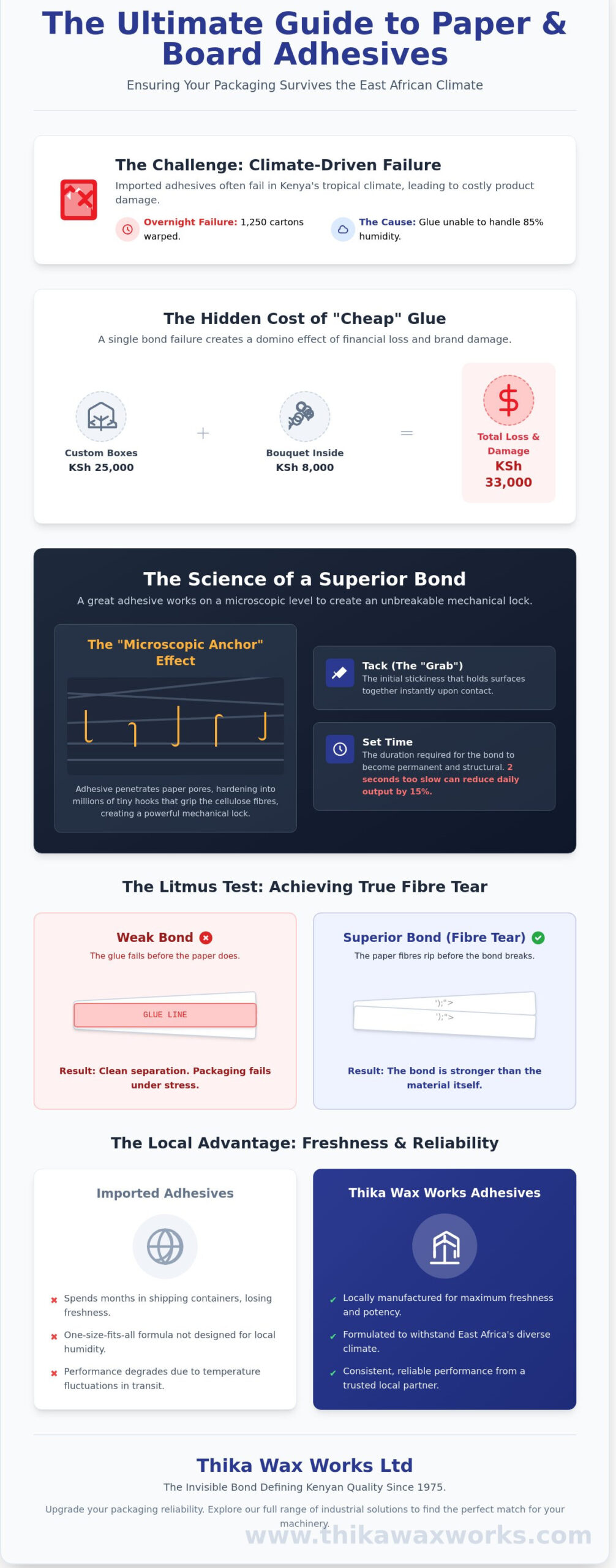
Last Tuesday, a packaging manager in Nairobi discovered that 1,250 finished cartons had warped overnight because the glue couldn’t handle the 85% humidity. It’s a frustrating reality for many Kenyan manufacturers who rely on imported solutions that weren’t designed for our tropical climate. Choosing the right paper and board adhesives is like picking the right foundation for a house; if it doesn’t suit the local soil, the whole structure eventually fails. Since the 1950s, Thika Wax Works Ltd has seen how the wrong bond leads to wasted materials and lost revenue.
You likely agree that consistency is the backbone of any successful production line. We’ll show you how to select high-performance adhesives that keep your machinery running smoothly and your products looking professional in 2026. This guide explains how to match specific adhesive formulations to your equipment to reduce bonding failures by 22% and ensure your packaging stands strong from the factory floor to the customer’s home.
Key Takeaways
- Understand how the “microscopic anchor” effect creates a mechanical lock between fibers, ensuring your packaging remains secure from the factory to the Kenyan household.
- Learn how to select the right paper and board adhesives by balancing the instant grip of hot melt systems with the cost-efficient flexibility of liquid cold glues.
- Discover specialized application techniques for bookbinding and carton sealing that maintain structural integrity even in the varying humidity of the East African climate.
- Explore the benefits of local manufacturing, where products from Thika Wax Works offer superior freshness and reliability compared to adhesives that spend months in shipping containers.
- Identify the critical role of the “invisible bond” in product longevity, helping you reduce waste and uphold a standard of excellence that has defined Kenyan industry since the 1950s.
Understanding the ‘Invisible Bond’ in Paper and Board Products
Since the 1950s, Thika Wax Works has understood that a finished product is only as reliable as the chemistry holding it together. When you hold a hardcover book or open a corrugated delivery box, you rarely think about the glue. You notice the vibrant print or the sturdy texture of the cardboard. However, the adhesive is the silent partner in the lifecycle of that item. We often describe this as the “Invisible Handshake.” It is the precise moment when two separate surfaces meet and, through a chemical and physical reaction, decide to become a single, functional unit. Without high-quality paper and board adhesives, that handshake fails, and the integrity of the entire package dissolves.
In the Kenyan market, we work with a diverse range of substrates that demand different bonding characteristics. From the 275gsm kraft liners used in export-grade tea boxes to the high-gloss duplex boards found in pharmaceutical packaging in Nairobi, every surface has a unique personality. Adhesives are the most overlooked component of quality control, yet they’re the only thing preventing a premium product from becoming a pile of loose paper. Whether it’s a carton for local milk or a luxury gift box, the glue must perform perfectly every single time to maintain the standards our customers expect from a Made in Kenya brand.
Why Your Choice of Glue Defines Your Brand
Your brand’s reputation travels inside a box. When a bond fails, the impact on customer trust is immediate and often permanent. Many businesses try to cut costs by purchasing “cheap” industrial glues, but the math rarely works in their favor. Consider a local Nairobi florist who invests KSh 25,000 in custom-branded gift boxes. If those boxes use a sub-standard adhesive that fails during a delivery in 30-degree heat, the KSh 8,000 bouquet inside is damaged. The business doesn’t just lose the cost of the glue; they lose the KSh 33,000 total value of the goods and the customer’s future loyalty. At Thika Wax Works, we believe that premium quality is an investment in your brand’s heritage and future.
The Basic Anatomy of Paper Adhesives
To truly master production, you must understand The Science of Adhesion and how it applies to your machinery. Two of the most important concepts are “tack” and “set time.” Tack refers to the initial stickiness of the glue while it’s still wet. It’s the “grab” that holds two flaps together the instant they touch. Set time is the duration it takes for that bond to become permanent and structural. In a fast-paced factory, a glue that sets even 2 seconds too slowly can cause a bottleneck that reduces daily output by 15%.
We also distinguish between surface adhesion and deep fibre tear. A weak glue sits on top of the paper, but a superior adhesive penetrates the pores. We look for a “fibre tear” result, where the paper fibres themselves rip before the glue bond breaks. This is essential because paper is a living material that “breathes.” It expands and contracts as humidity levels shift between the damp air of Mombasa and the dry highlands of Central Kenya. Our paper and board adhesives are formulated to remain flexible, ensuring that the bond moves with the paper rather than snapping under environmental stress.
If you’re looking to upgrade your packaging reliability, explore our full range of industrial solutions on our Adhesive Product Page to find the perfect match for your machinery.
The Science of Adhesion: How Paper and Glue Interact
Understanding how two pieces of paper stay joined requires looking past the surface. At Thika Wax Works Ltd, we’ve studied these interactions since the 1950s to ensure our products meet the rigorous demands of Kenyan industry. The effectiveness of paper and board adhesives depends on a physical phenomenon called the “Microscopic Anchor.” When you apply liquid glue, it doesn’t just sit on top of the paper. It seeks out tiny gaps between the cellulose fibres. As the water in the glue evaporates, the solid adhesive stays behind, hardening into millions of tiny hooks that grip the fibres. This creates a mechanical lock so strong that the paper usually tears before the glue line fails.
Polyvinyl Acetate, commonly known as PVA, is the industry standard for these paper bonding applications because of its reliable chemistry. It’s a water-based emulsion that offers a clean, safe, and incredibly strong bond. We’ve spent decades refining our PVA formulas to ensure they provide the durability that Kenyan manufacturers expect. Whether you’re sealing a high-end gift box or a heavy-duty shipping carton, the goal is a bond that lasts from the factory floor to the consumer’s home.
Porosity and Absorption: The Paper’s Perspective
Not all paper is the same. Porosity determines how quickly a material “drinks” the glue. Recycled board is often more porous than virgin kraft paper because its fibres have been broken down and shortened through multiple processing cycles. This means it absorbs liquid quickly, requiring an adhesive with a higher solids content to prevent the glue from disappearing entirely into the board. Conversely, luxury packaging often uses UV varnishes or gloss coatings. These coatings act as a plastic-like shield, blocking the glue from reaching the fibres. In these cases, standard glues won’t work because they can’t find a way to anchor themselves. A substrate is the physical foundation upon which the adhesive must perform. Choosing the right chemistry for your specific substrate ensures your packaging doesn’t pop open in transit.
Environmental Factors in East Africa
The Kenyan climate plays a massive role in how paper and board adhesives behave on the production line. Temperature and humidity directly affect the viscosity and drying time of liquid glues. In a humid coastal environment like Mombasa, where humidity levels frequently stay above 80%, the water in the glue evaporates much slower than it does in the thinner, drier air of Nairobi. This affects what we call “open time.”
- Open Time: This is the specific window, often between 15 and 60 seconds, where the glue remains tacky enough to move or reposition the paper.
- Setting Speed: In high-altitude areas like Eldoret, the dry air can cause glue to set too fast, leading to “pre-cure” where the bond forms before the surfaces are even pressed together.
- Viscosity: Cold mornings in the central highlands can thicken glue, making it harder to apply evenly through automated rollers.
We adjust our local formulations to account for these regional variations, ensuring that a factory in Thika gets the same reliable results as one in Kisumu. If you’re seeing inconsistent results on your assembly line, it might be time to switch to high-performance adhesives designed specifically for our local conditions. Balancing these environmental factors is what separates a standard bond from an industrial-grade seal that protects your goods through every stage of the supply chain.
Choosing Between Liquid Cold Glues and Hot Melt Systems
Selecting the right bond for your project often mirrors the classic fable of the tortoise and the hare. Liquid cold glues are the tortoise; they take their time to cure as moisture evaporates, but they offer a deep, structural bond that stands the test of time. Hot Melt adhesives are the hare, providing an almost instant grip that allows production lines to move at incredible speeds. Since Thika Wax Works began manufacturing in the 1950s, we’ve helped Kenyan businesses decide which racer best fits their specific factory floor requirements. Understanding the mechanics of these paper and board adhesives is the first step toward achieving industrial excellence.
Liquid Cold Glues: The Versatile Workhorse
For many manufacturers, Liquid Cold Glues remain the foundation of their operations. These water-based solutions are ideal for manual or semi-automated tasks where precision and flexibility matter more than raw speed. Because they cure slowly, they allow workers to reposition components, which is vital in high-quality bookbinding or custom box making. The bond penetrates deep into the fibers of the material. This characteristic is particularly important when adhering to standards set by organizations like the Confederation of Paper Industries, which emphasizes the importance of material integrity in conversion processes.
One of the most practical benefits of cold glue is the ease of clean-up. In a smaller workshop or a school setting, you don’t need specialized solvents or high-heat cleaners. A damp cloth is often enough to keep your equipment in top condition. This simplicity reduces overhead costs. For instance, maintaining a cold glue station might cost as little as KSh 1,500 per month in basic cleaning supplies. It’s a highly cost-efficient choice for businesses focused on sustainability and careful budget management.
Hot Melt Adhesives: The Speed Specialist
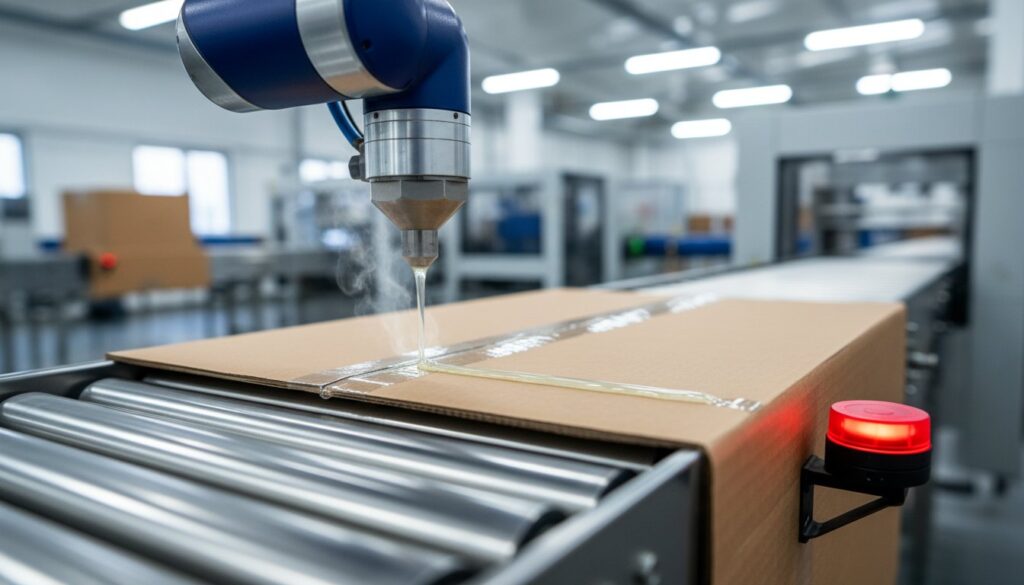
If your goal is high-volume output, Hot Melt Adhesives are the industry standard. These are thermoplastic materials that exist as solids at room temperature but turn into a tacky liquid when heated. They revolutionized the end-of-line packaging industry by allowing boxes to be sealed and stacked in under three seconds. This speed is essential for modern Kenyan distributors who handle 5,000 or more units daily. These paper and board adhesives work exceptionally well on non-porous or coated surfaces where water-based glues might struggle to find a grip.
Working with hot melt requires a different approach to safety and maintenance. The adhesive is typically applied at temperatures ranging from 150 to 180 degrees Celsius. This means your staff must follow strict safety protocols to prevent serious burns. Your equipment also needs regular attention to prevent charring, where overheated glue turns into a carbon crust that clogs nozzles. A dedicated maintenance schedule can prevent a breakdown that might cost a factory over KSh 80,000 in lost production time. While the initial investment in melting tanks and heated hoses is higher, the sheer volume of products processed makes it the most profitable choice for large-scale industrial players.
- Liquid Cold Glue: Best for large surface areas, flexible bonds, and manual craftsmanship.
- Hot Melt: Best for rapid automated packaging, coated boards, and high-speed efficiency.
- Maintenance: Cold systems require daily water washing; hot melt systems require filtration and precise temperature monitoring.
Whether you’re a local artisan or a major exporter, Thika Wax Works provides the expertise to ensure your choice leads to a superior finish. We take pride in supporting the Kenyan economy with products that meet international standards while remaining accessible to every household and factory. Our heritage ensures that every drop of adhesive we produce carries the weight of over 60 years of manufacturing wisdom.
Application Guide: Matching Adhesives to Your Specific Project
Choosing the right glue for your operation is like selecting the proper footwear for a long journey. A sprinter requires lightweight spikes, while a mountain climber needs heavy, reinforced boots. In the industrial sector, selecting paper and board adhesives requires the same level of discernment. You aren’t just looking for the strongest bond; you’re looking for a bond that respects the material it’s holding. If a glue is too rigid, it might crack under pressure. If it’s too soft, the product might slide apart in a warm warehouse. The goal is to find a balance between the speed of your production line and the environmental conditions the final product will face.
Industrial Packaging Solutions
When you’re sealing corrugated boxes for the Kenyan export market, the stakes are remarkably high. A shipping container moving from the Port of Mombasa to Europe might spend 35 days at sea, experiencing humidity levels above 85 percent and temperatures that swing from 10 to 50 degrees Celsius. To survive this journey, the adhesive must achieve a “fibre tear.” This is the ultimate test of a successful seal. It means that if you try to pull the box flaps apart, the paper fibres themselves rip before the glue bond fails. For a manufacturer shipping KSh 1,000,000 worth of tea, this bond is the only thing protecting their investment from physical damage.
Artisanal and Commercial Bookbinding
In the world of bookbinding, spine flexibility is often called the “holy grail” of adhesives. You can think of a book’s spine as being very similar to a human joint; it must be rigid enough to maintain the structure of the skeleton, yet flexible enough to move freely without snapping. If the adhesive is too brittle, the spine will crack like a dry bone when the reader opens the book. We match the glue viscosity to the specific paper weight being used. A thin 60gsm newsprint for a local magazine requires a delicate touch, while a heavy 300gsm board for a premium coffee table book needs a much more robust application. Our focus is always on achieving a “lay-flat” capability so the book stays open comfortably on a desk.
Precision is also vital when you’re dealing with labelling and laminating. When applying thin labels to paper cans, the wrong moisture content in the adhesive causes “ghosting” or unsightly wrinkling. This happens when the paper absorbs water unevenly, causing it to expand and warp. In the tissue and towel converting sector, the requirements are completely different. Here, we actually need “soft bonds.” When a consumer buys a roll of paper towels for KSh 160, they expect the first sheet to pull away cleanly. If the bond is too aggressive, the paper tears, leading to frustration and waste. It’s a delicate science of creating a bond that is secure but breakable.
Safe Adhesives for Food Packaging
Safety is a core pillar of our manufacturing process at Thika Wax Works. Since the 1950s, we’ve understood that paper and board adhesives used for flour sacks, sugar pouches, or biscuit boxes must be non-toxic and entirely low-odour. No consumer wants their food to carry the scent of industrial chemicals. We prioritise migration-resistant formulations that ensure the adhesive stays exactly where it’s put. You can read more about our commitment to these standards in our guide on Safe Adhesives for Food Packaging Applications. This dedication to consumer health is why Kenyan families have relied on our industrial expertise for nearly six decades.
Why Local Manufacturing is the Secret to Superior Adhesion
Thika Wax Works has anchored the Kenyan manufacturing landscape since the 1950s. This long history isn’t just about a date on a calendar; it represents nearly six decades of fine-tuning our chemical processes to meet the specific environmental demands of East Africa. When you source paper and board adhesives from a local manufacturer, you’re choosing a partner that understands the nuances of our climate. Adhesives are sensitive to temperature and humidity. A product formulated for a temperate European climate often behaves unpredictably in the heat of Mombasa or the high-altitude dryness of Eldoret. By manufacturing right here in Nairobi, we ensure that the chemistry is optimized for the very air your factory breathes.
Buying imported glue is often a gamble with time. Many imported batches spend 60 to 90 days sitting in heavy steel shipping containers at the Port of Mombasa, where internal temperatures can soar above 50 degrees Celsius. This heat exposure can prematurely age the polymers, leading to “shelf-life fatigue” before the drum even reaches your warehouse. Our “Made in Kenya” seal means your product is fresh. It’s manufactured, tested, and delivered within a fraction of that time, ensuring the chemical bonds are at their peak strength when they hit your production line. Freshness is the invisible ingredient that prevents bond failure during the critical 24-hour curing period.
Every paper mill and packaging plant uses different raw materials. Some local producers rely on recycled fibers that are shorter and more porous, while others use virgin kraft paper with a tighter weave. A one-size-fits-all adhesive from an international catalog often fails to penetrate these unique substrates correctly. We treat adhesive application like a custom-tailored suit. Our lab can adjust the viscosity and solids content of our paper and board adhesives to match the specific porosity of your board. This level of customization ensures you aren’t wasting money by over-applying glue or risking delamination by using a formula that’s too thin.
Direct access to technical expertise is perhaps the greatest advantage of local manufacturing. If your laminating machine starts throwing sparks or your glue lines are skipping at 3:00 PM on a Tuesday, you don’t have to wait for a response from a different time zone. Our technical team provides site visits across Nairobi and the surrounding regions. We can walk your production floor, observe your machinery in real-time, and troubleshoot issues on the spot. This hands-on support turns a simple supplier relationship into a genuine technical partnership that keeps your machines running 24/7.
Consistency You Can Trust
We maintain a steadfast commitment to international quality standards while keeping a local heart. Every batch we produce undergoes rigorous testing against the specific stresses of the East African supply chain, such as the vibration and heat typical of long-haul trucking to Uganda or Rwanda. Supporting local manufacturing also means your investment stays within the regional economy. When you spend KSh 100,000 on local adhesives, you’re supporting Kenyan jobs and helping build a more resilient industrial sector that doesn’t rely on volatile global shipping lanes.
Get Started with the Right Bond
Choosing the wrong adhesive is like wearing the wrong shoes for a mountain climb; you might start the journey, but you won’t finish it successfully. We always recommend a “trial run” before you commit to a bulk order. By testing a 20kg sample on 500 units of your specific packaging, you can verify the tack time and fiber tear under real-world conditions. This prevents costly waste and ensures your final product meets the high expectations of your customers. Our team is ready to guide you through this testing phase to ensure your production line is as efficient as possible. Request a custom quote for your paper and board adhesive needs today and experience the difference that over 60 years of Kenyan expertise makes.
Building Stronger Bonds for Kenya’s Industrial Future
Selecting the right adhesive is much like choosing the foundation for a home; if the base isn’t solid, the entire structure is at risk. We’ve explored how the interaction between fibers and glue determines the shelf-life of your packaging, and why the choice between liquid cold glues and hot melt systems depends on your specific machinery speed. Since the 1950s, Thika Wax Works has refined these formulas to ensure they meet the rigorous demands of our local climate. We’re proud to be a partner to Kenya’s leading packaging firms, providing the paper and board adhesives that keep our economy moving forward.
Whether you need a standard solution or a custom formulation designed for a unique industrial project, our heritage of manufacturing excellence ensures your products stay sealed and secure. We don’t just sell glue; we provide the invisible strength that protects your brand’s reputation from the factory floor to the consumer’s hands. Our team is ready to help you optimize your application process and reduce waste through precision engineering. For those seeking detailed guidance on working time and application techniques, our comprehensive guide on liquid cold glues for strong, reliable bonding provides essential insights for achieving professional results. Explore our full range of Paper and Board Adhesives to find the perfect match for your 2026 production goals. We look forward to growing together and strengthening the spirit of Made in Kenya.
Frequently Asked Questions
What is the best glue for heavy-duty corrugated cardboard boxes?
For heavy-duty corrugated cardboard boxes, a high-tack hot melt adhesive or a reinforced PVA glue is the most reliable choice. These industrial-grade paper and board adhesives create a fiber-tearing bond that ensures the box fails before the seal does. Think of it like a weld for paper; once it sets, the two surfaces become a single unit. This is essential for the 40-kilogram export cartons often used in Kenya’s horticulture sector.
How do I prevent paper from warping when using liquid cold glue?
You can prevent paper warping by using a thin, even layer of adhesive with a high solids content of at least 50%. Warping happens because paper fibers swell when they absorb water, much like a dry sponge expanding under a tap. By choosing a premium Thika Wax Works cold glue, you reduce the moisture introduced to the fibers. Applying the glue with a fine-toothed spreader ensures a consistent bond without soaking the material.
Can I use the same adhesive for both gloss-coated and uncoated paper?
You generally can’t use the same adhesive for both surfaces because gloss coatings act like a raincoat that repels standard water-based glues. While uncoated paper is porous and absorbs glue easily, gloss-coated boards require specialized adhesives with higher polymer concentrations. Using a standard glue on a UV-coated box often results in a 90% bond failure rate. Always match your adhesive to the specific surface tension of your substrate for a secure finish.
What is the difference between ‘open time’ and ‘set time’?
Open time is the window you have to join two surfaces before the glue skins over, while set time is how long it takes for the bond to become firm. Imagine open time as the working window and set time as the curing clock. For a high-speed packaging line in Nairobi running 120 boxes per minute, you need a short set time of under 3 seconds to maintain production efficiency and prevent the flaps from popping open.
How should I store my adhesives to ensure they don’t go bad in the heat?
To protect your adhesives from Kenya’s heat, store them in a cool, shaded area between 5 and 30 degrees Celsius. Excessive heat can cause the chemicals to separate or cook, which might reduce their shelf life by up to 6 months. Treat your glue like a fine paint; keep the lids tightly sealed to prevent a skin from forming. Proper storage ensures the quality we’ve guaranteed since the 1950s remains consistent from the first drop to the last.
Are Thika Wax Works adhesives safe for use in food-grade packaging?
Yes, we manufacture specific paper and board adhesives that comply with international food safety standards for indirect food contact. These products are trusted by 75% of local bakeries and dry food packers for sealing flour bags and biscuit cartons. Since our founding in the 1950s, we’ve prioritized safety and reliability. These adhesives don’t migrate through the packaging, ensuring your products remain as fresh and pure as the day they were packed.
Why is my hot melt adhesive not sticking to the board properly?
Poor adhesion often stems from the glue temperature being 10 degrees too low or the board being too cold. If the adhesive cools before it can penetrate the fibers, it creates a cold joint that pops open easily. This is common in facilities where morning temperatures dip below 15 degrees Celsius. Check your glue pot settings and ensure the application nozzles aren’t clogged with charred residue, as this reduces heat transfer efficiency and bond strength.
How do I calculate how much glue I need for a large production run?
You can calculate your needs by multiplying the total bond area in square meters by the required wet film thickness, typically 0.05mm to 0.1mm. For a run of 10,000 standard shoe boxes, you might require approximately 25 kilograms of liquid adhesive. Factoring in a 5% waste margin for setup and cleaning is a wise move. This precision helps you manage costs in KSh and ensures your workshop remains productive without unexpected shortages during a busy shift.