
Last Tuesday, a carpenter in Nairobi watched as a bookshelf he spent 14 hours building fell apart because his glue dried too quickly to get the joints square. It’s a common headache that ruins good work and wastes expensive timber. We all want our projects to stand the test of time; yet many of us struggle with adhesives that are either too messy or simply too weak for the Kenyan humidity. You deserve a bond that’s as reliable as a handshake from an old friend. This is why understanding how to use liquid cold cold glues is essential for anyone building or repairing items at home.
We agree that nothing is worse than a bond that fails after just a few days of use. This guide promises to show you how to find a glue that gives you enough time to move your pieces into place without the stress of a ticking clock. You’ll discover the secret to long-lasting bonds and how to choose the right product for your specific project. We will look at the benefits of using local formulas developed by Thika Wax Works since the 1950s and how they outperform generic imports in our unique climate. From furniture repairs to school projects, you’re about to learn how to stick things together for good.
Key Takeaways
- Understand how liquid cold glues act like “liquid velcro” to soak into surfaces and create a bond that lasts for years.
- Learn the difference between PVA and Dextrin adhesives so you can pick the right “flour” for your specific project.
- See why cold glue is like a marathon runner, taking its time to set but providing a much deeper and stronger bond than quick-setting alternatives.
- Master the “Goldilocks” rule of application to ensure your surfaces are perfectly prepared for a professional, mess-free finish.
- Discover why Kenyan manufacturers have trusted our locally made, world-class adhesives to hold their products together since the 1950s.
What Are Liquid Cold Glues and How Do They Work?
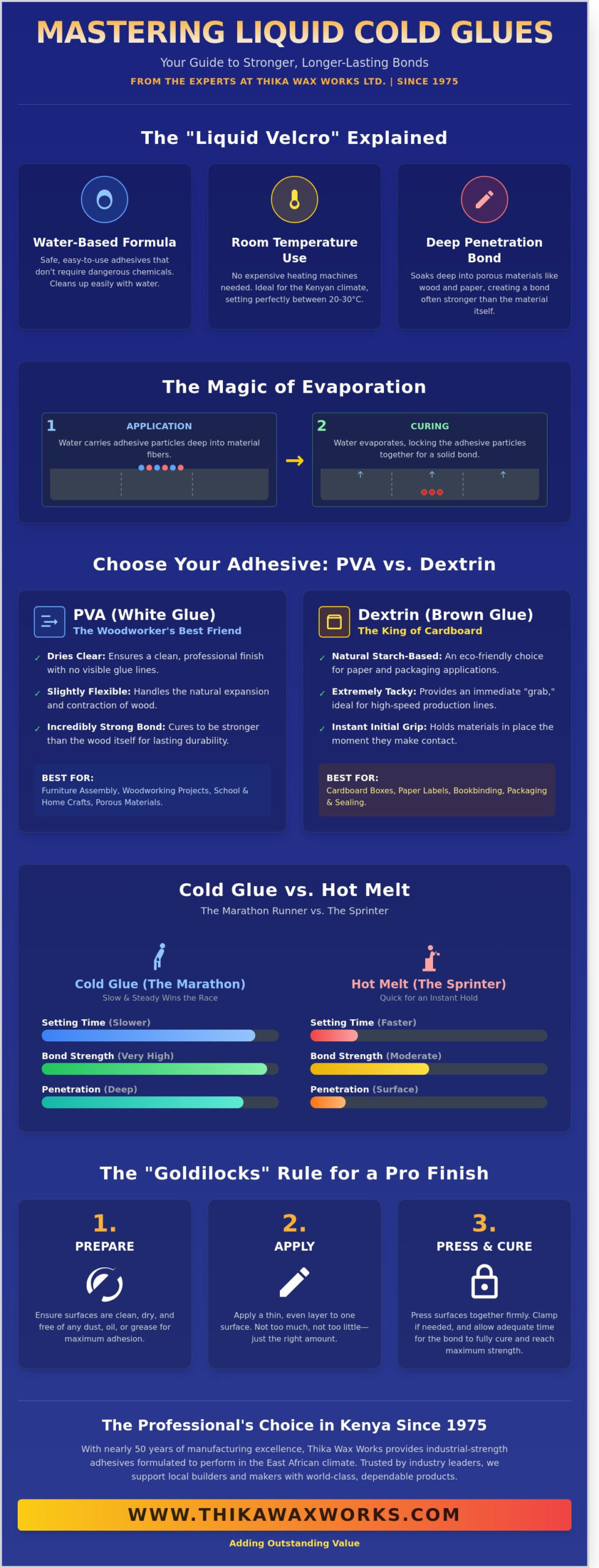
Liquid cold glues are a staple in both Kenyan factories and homes. These are water-based adhesives that work perfectly at room temperature. You don’t need expensive heating machines or dangerous chemicals to make them stick. Since the 1950s, Thika Wax Works has provided these reliable solutions to help builders and makers across the country. Think of them like liquid velcro. When you apply the glue, it behaves like a liquid that “drinks” into the surface of materials like wood or paper. This deep soaking action is what makes the final connection so incredibly tough.
To better understand how these adhesives perform in the real world, watch this helpful video:
The Magic of Evaporation
How does a wet liquid turn into a rock-solid bond? It’s all about evaporation. Imagine a muddy puddle on a warm day in Thika. As the sun comes out, the water disappears into the air. What’s left behind is a hard, dry crust. A quality Adhesive works the same way. The water in the glue carries the sticky parts deep into the fibers of your material. Once the water leaves, those sticky parts lock together. This creates a bond that’s often stronger than the wood or cardboard itself. It’s a simple, natural process that ensures your projects stay together for decades. Because they set at normal temperatures between 20 and 30 degrees Celsius, they’re much safer to handle than hot alternatives.
Common Uses in Everyday Life
You see the work of liquid cold glues every single day without even realizing it. They’re the reason the label stays on your soda bottle during a humid afternoon. They keep your cereal boxes sealed tight in the pantry. These adhesives are the backbone of paper and board adhesives used in local manufacturing. They’re also why your favorite books don’t lose their pages and your wooden chairs don’t wobble. Thika Wax Works takes pride in making these essential products right here in Kenya. We focus on industrial reliability so that every bond you make is one you can trust.
- Soda and Food Labels: Keeps packaging looking professional and intact.
- Bookbinding: Ensures pages stay securely attached to the spine.
- Furniture Assembly: Provides a deep bond for porous wood surfaces.
- Cardboard Boxes: Seals shipping containers for safe transport across the region.
If you’re looking for a bond that lasts, explore our full range of liquid cold glues to find the perfect match for your next project.
The Two Main Flavours: PVA vs. Dextrin Adhesives
Picking the right glue is a lot like choosing flour for baking. You wouldn’t use self-raising flour to thicken a soup, and you wouldn’t use bread flour to make a light sponge cake. In the same way, different types of liquid cold glues serve very specific purposes in your workshop or factory. Since the 1950s, Thika Wax Works has seen how the right choice makes the difference between a job that lasts and one that falls apart. Most people use two main types: PVA and Dextrin.
Choosing between them depends on what you are sticking and how fast you need it to stay put. While both are water-based, they behave differently once they leave the bottle. One is a powerhouse for heavy construction, while the other is a specialist for paper and packaging.
PVA: The Woodworker’s Best Friend
PVA, or Polyvinyl Acetate, is the famous White Glue found in almost every Kenyan home and school. You can think of it as a liquid plastic that stays slightly flexible even after it sets. It is the top choice for woodworking projects because it sinks deep into the wood fibers. Once it dries, the bond is often stronger than the wood itself. This U.S. government fact sheet explains how water-based glues like these harden as the moisture evaporates into the air or the material.
A major benefit of PVA is that it dries clear. This ensures your finished furniture or craft looks professional and clean without ugly white spots showing at the joints. It is a reliable partner for anyone building a legacy of quality work. Because it’s a plastic-based formula, it handles the natural movement of wood as temperatures change in the home.
Dextrin: The King of Cardboard
Dextrin is often called Brown Glue. It’s made from natural starch, which makes it a favorite for eco-friendly packaging and paper products. It is very tacky, meaning it feels sticky to the touch the moment you apply it. This instant “grab” is why factories love it for high-speed labeling on bottles or making paper tubes. If you’ve ever looked at the brown core of a toilet paper roll, you’ve seen Dextrin at work.
- It’s perfect for high-volume paper tasks.
- The natural formula is safe for many types of packaging.
- Cleanup is simple; you only need plain water to wash away spills.
Whether you are running a large factory or finishing a project at home, our range of liquid cold glues provides the steady performance you expect from a local champion. Using the right “flour” for your project ensures the results are always excellent.
Cold Glue vs. Hot Melt: Which One Wins?
Choosing the right adhesive is like picking a runner for a race. A hot melt glue is a sprinter. It finishes the job in seconds. On the other hand, liquid cold glues are marathon runners. They take a bit longer to cross the finish line, but they provide a bond that lasts much longer. Since the 1950s, Thika Wax Works has provided reliable solutions for Kenyan industries. We know that the “instant” choice isn’t always the best one for every job.
Hot melt glues rely on heat to work. While they set fast, they also have a weakness. They can melt again if the weather gets too hot. In many parts of Kenya where temperatures rise during the day, this is a real risk for your products. Cold glue dries through evaporation. Once it sets, it stays set. It handles humidity and heat without losing its grip. It is also much cheaper to start using. You don’t need to buy a heating machine that might cost KSh 45,000. You also save on the electricity costs required to keep those machines running all day. You simply open the container and start working.
The Benefit of “Wiggle Room”
One of the best things about cold glue is what we call “Open Time.” This is the window of time you have to move your materials before the glue dries completely. Think of it like adjusting a picture frame on your wall. You want to have a moment to make sure it is perfectly straight before it stays there forever. If you use hot melt, you have about three seconds to get it right. With cold glue, you have several minutes to slide pieces into place. This prevents expensive mistakes on complex assembly lines where parts must be aligned with total precision. If speed is your priority, learn how a hot melt adhesive for product assembly can move your production line up to 40% faster.
Strength and Durability Over Time
Cold glue wins on strength because of how it interacts with surfaces. It creates a mechanical lock by soaking deep into the fibers of the material. Hot melt glues act more like a layer of plastic sitting on the surface. If the temperature drops suddenly at night, hot melt can become brittle and “pop” off the material. Liquid cold glues remain flexible and tough. The glue actually becomes a part of the item itself. If your project requires extreme speed for simple packaging, you might prefer our hot melt adhesives. However, for furniture or heavy duty boxes, the deep bond of cold glue is the trusted choice for quality that lasts for decades.
To see our full range of high-quality bonding products, please visit our liquid cold glues page and choose the best fit for your needs.
How to Apply Liquid Adhesives Like a Pro
Since the 1950s, Thika Wax Works has helped Kenyans build and repair things that last. We know that a strong bond is about more than just the glue in the bottle. It is about how you use it. Preparation is 90% of the job. If your surfaces are dirty, even the best liquid cold glues will fail. Dust, oil, and moisture act like a wall between the glue and the material. You must clean every surface until it is spotless. A clean surface is a happy surface, and it ensures your hard work doesn’t fall apart after a few weeks.
Getting the amount of glue right is also vital. We follow the “Goldilocks” rule: you don’t want too much, and you don’t want too little. If you use too little, the joint will be “starved” and brittle. If you use too much, you waste money and create a mess. In Kenya, where a high-quality 500g tub of adhesive might cost around KSh 450, using just what you need is smart for your pocket. Look for a tiny bead of glue to pop out when you press the pieces together. This “squeeze-out” tells you that you used the perfect amount.
The Perfect Spread
Think of applying glue like spreading butter on a fresh slice of bread. You want a thin, even layer that reaches every single corner. If the glue is lumpy or has dry spots, the bond will be weak. To get this right, you should use quality paint brushes. A good brush helps you paint the adhesive onto the fibers evenly. This ensures the glue penetrates the material instead of just sitting on top. It makes the difference between a project that looks amateur and one that looks like it came from a professional workshop.
The Importance of the “Hug” (Clamping)
Once the glue is on, the materials need a firm hug. This is what we call clamping. Pressure is necessary because it forces the liquid cold glues to “knit” into the pores of the wood or fabric. Without this pressure, the glue cannot form those tiny anchors that hold everything together. For most home projects, you should keep the clamps on for at least 30 minutes. However, do not rush the process. Let the item sit undisturbed for 24 hours to reach its full strength. This patience ensures the bond is permanent and can handle the weight or stress of daily use.
Good cleanup habits keep your workspace efficient and your tools ready for the next job. Always keep a damp cloth nearby to wipe away extra glue while it is still wet. Once these adhesives dry, they are much harder to remove and might require heavy sanding. If you take care of your tools, they will serve you for decades, just as our products have served Kenyan households for over 60 years.
Are you ready to start your next repair or build? Browse our selection of liquid cold glues to find the reliable bonding solution you need today.
Why Industry Leaders Trust Thika Wax Works
Since the 1950s, Thika Wax Works has served as the backbone of Kenyan manufacturing. We’ve spent over 60 years perfecting the art of bonding. Our liquid cold glues are more than just industrial products. They represent a long heritage of quality that protects your business reputation. When you use our products, you’re using decades of “sticky” expertise that we’ve gathered from working with thousands of factories. We treat every batch of glue like a master builder treats a foundation. This commitment ensures that your finished goods stay together, whether they are sold in a local shop or sent across the border.
Choosing a partner for your manufacturing needs is a big decision. You need a brand that understands the local market and the challenges you face every day. We provide a level of reliability that only comes from over six decades of experience. Our products meet international standards while keeping a local heart. This balance makes us the trusted choice for both large distributors and small family workshops. We don’t just sell you a bottle; we offer a promise of performance that has been tested for generations.
Made in Kenya, for Kenya
Supporting the regional economy feels good, but it also makes great business sense. Since we manufacture our products right here, your glue doesn’t sit in a hot shipping container for six weeks. You receive fresh glue delivered to your door much faster than any import. This freshness is vital because it means the bond is stronger and the shelf life is longer. Every KSh you spend with us stays in Kenya, helping to build our schools and support our local communities. We’ve served three generations of Kenyan craftsmen, and we take pride in being a local champion for quality.
Expert Support at Every Step
Picking the right adhesive shouldn’t be a guessing game. It’s like picking the right shoes for a long walk; the wrong fit leads to problems down the road. Our team of experts helps you choose the perfect glue for your specific machine speed or wood type. Using the wrong product can cost your business 10,000s of KSh in wasted materials and customer complaints. We prevent those mistakes by offering guidance before you even make a purchase. If you have a unique project, we invite you to contact us for a custom solution that fits your needs. Our goal is to make your production line run as smoothly as possible.
We believe that consistency is the key to a successful business. That’s why we never chase trends or cut corners on our ingredients. We stay focused on what works. You can count on our liquid cold glues to perform the same way every time you open a container. Ready to see the difference that over 60 years of experience makes? Explore our full range of liquid cold glues today!
Build Better Bonds Today
Choosing the right adhesive is like picking the foundation for a home. You want something that holds firm and lasts for years. Whether you’re sealing boxes in a busy factory or finishing a project at the kitchen table, liquid cold glues provide a reliable bond that won’t let you down. Since the 1950s, Thika Wax Works has manufactured these high-quality adhesives right here in Kenya. We’ve spent over 60 years perfecting formulas that offer superior strength for every industrial application. Our expert technical team is always ready to help you choose between PVA and Dextrin so you get the best results for your KSh. You don’t have to worry about complicated tools or dangerous heat. Just apply, set, and trust in a product made with local pride and international standards. We’re here to make sure your work stays together as long as you need it to.
Browse Our Premium Liquid Cold Glues
We look forward to helping you create something that lasts.
FAQFrequently Asked Questions
Is liquid cold glue waterproof once it dries?
Most liquid cold glues are water-resistant but they aren’t fully waterproof. You can think of the bond like a cotton shirt; it handles a light splash just fine, but it shouldn’t stay submerged in a pool for 24 hours. For household items or indoor furniture in Kenya, this glue provides a trusted and steady hold against daily wear. If you’re building something that stays outdoors in heavy rain, you’ll need a specialized marine adhesive instead.
How long does it take for cold glue to dry completely?
It usually takes about 30 minutes for the glue to set and 24 hours to dry completely. Since the 1950s, we’ve seen that the first 60 minutes are the most important for the bond to grip properly. You should keep your materials clamped or held still during this initial window to ensure a superior finish. After a full day has passed, the bond becomes a permanent part of the material’s structure.
Can I use liquid cold glue on plastic or metal surfaces?
Liquid cold glues work best on porous materials like paper, wood, and cardboard rather than smooth plastic or metal. Imagine trying to stick a stamp onto a block of ice; the glue simply has nothing to grab onto. These glues need tiny, microscopic holes in the surface to soak into and lock tight. For metal repairs or plastic bonding, it’s better to browse our industrial range for a product designed for non-porous surfaces.
What is the shelf life of a typical industrial liquid glue?
A typical industrial liquid glue stays fresh and effective for 12 months when you store it in a cool, dry place. We ensure every bottle leaving our Kenyan factory meets high standards for durability and long-lasting performance. If the glue looks like thick porridge or smells sour after 1 year, it’s time to replace it. Always keep the lid tightly sealed to prevent the air from drying out your supply prematurely.
Is liquid cold glue safe for food packaging?
Many of our liquid glues are safe for food packaging because they don’t contain harsh chemicals that migrate through paper. This makes them a premium choice for local bakeries and flour millers who need reliable seals for their bags and boxes. They create a strong bond on the outside of the package while keeping the contents safe for your family. We’ve provided these essential solutions to the Kenyan packaging industry for over 60 years.
How do I remove dried liquid glue from my tools or hands?
You can remove dried glue from your hands or tools using warm soapy water and a little bit of scrubbing. For tougher spots on metal tools, a mixture of 50 percent white vinegar and 50 percent water helps soften the bond quickly. It’s just like cleaning dried food off a dinner plate; a good soak makes the residue slide right off. Always wash your brushes immediately after use to keep them soft for your next project.
Does cold glue work better than hot melt for woodworking?
Cold glue is often better for woodworking because it soaks deep into the wood fibers to create a heritage-quality bond. While hot melt dries in seconds, cold glue gives you 10 minutes to adjust your pieces so they’re perfectly aligned. It’s the difference between a quick repair and a piece of furniture that stays strong for generations. Professional carpenters across Kenya have relied on this steady strength since our founding in the 1950s.
Why is my glue taking so long to set in humid weather?
Your glue takes longer to set in humid weather because the extra moisture in the air prevents the water in the glue from evaporating. In coastal areas like Mombasa where the air is heavy, drying times can increase by 50 percent compared to drier regions. Think of it like hanging laundry on a cloudy day; the fabric just needs more time to release its moisture. Using a small fan to move the air can help speed up the drying process.

Akshay Chandaria is the Sales Director at Thika Wax Works Limited, a manufacturer of industrial waxes, hot melt and cold glue adhesives, floor polishes, cleaning products and construction chemicals for businesses across Kenya.