
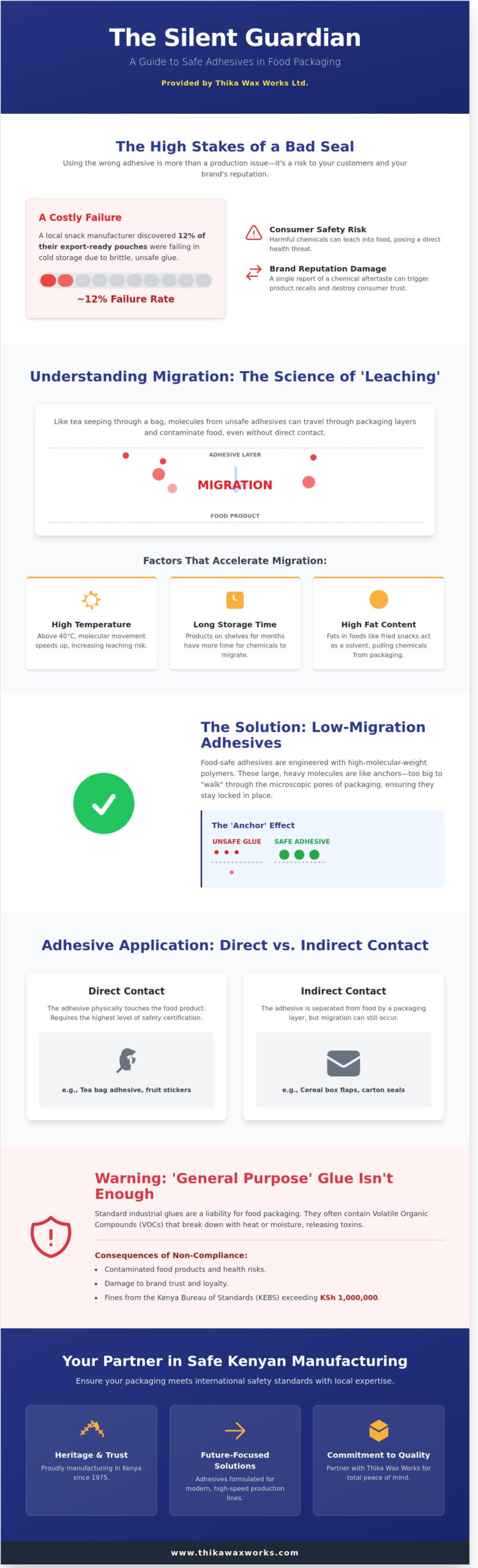
Last June, a local snack manufacturer in Nairobi discovered that 12% of their export-ready pouches were failing in cold storage because the glue turned brittle. It’s a stressful situation that puts both your reputation and consumer safety at risk. We know you care deeply about protecting your customers from chemical leaching while keeping your production lines running smoothly. Finding safe adhesives for food packaging is like choosing the right foundation for a home; if it isn’t solid and non-toxic, the whole structure is compromised.
Since the 1950s, Thika Wax Works Ltd has provided Kenyan businesses with the reliability they need to compete globally. This guide will help you identify the right food-safe glues to ensure your packaging meets international standards while maintaining a perfect seal in high-humidity environments. We’ll clarify the difference between direct and indirect food contact and show you how to maintain a long shelf-life for your goods. By the end, you’ll know exactly how to select a trusted local supplier for your industrial adhesive needs.
Key Takeaways
- Understand the science of chemical migration and how to prevent substances from leaching through your packaging like tea through a bag.
- Identify the most effective safe adhesives for food packaging to protect consumers while maintaining a high-quality, durable seal.
- Compare the benefits of hot melt versus liquid cold glues to find the perfect balance between fast production lines and safety requirements.
- Evaluate how local environmental factors, such as the heat in a Nairobi warehouse, impact the performance and reliability of your packaging glue.
- Discover why partnering with a trusted Kenyan manufacturer like Thika Wax Works ensures your products meet international safety standards with local expertise since the 1950s.
The Hidden Role of Adhesives in Food Safety
When you pick up a carton of milk or a box of maize meal at a local supermarket in Nairobi, you probably don’t think about the glue holding the flaps together. You see a sturdy container, but that seal is actually a silent guardian of your family’s health. Since the 1950s, Thika Wax Works has manufactured products that prioritize this quiet protection. A seal is much more than just a way to keep a box closed. It’s a barrier that ensures the food inside remains as pure as when it left the factory. We’ve spent decades perfecting these bonds to ensure they meet the highest standards of industrial reliability and domestic care.
We like to think of a package as a handshake. It’s the first physical interaction a brand has with a consumer. A firm, clean handshake builds trust, while a sticky or chemical-scented one creates immediate doubt. Using safe adhesives for food packaging ensures this greeting is always positive. These substances are specifically engineered to minimize the transfer of chemicals from the packaging material into the food itself. This process is a critical concern for anyone manufacturing Food Contact Materials. If an adhesive isn’t stable, it can leach harmful substances into the very meal you’re about to serve.
Choosing the wrong adhesive does more than just ruin a batch of product. It can devastate a brand’s reputation overnight. A 2024 survey of Kenyan retail trends showed that 82% of shoppers prioritize safety labels over price when buying for their children. One single report of a chemical aftertaste can lead to a total product recall. This isn’t just a logistical nightmare; it’s a public health risk that no responsible manufacturer should take. Our commitment to excellence means we provide the tools to keep your brand’s promise of safety intact.
Direct vs. Indirect Food Contact
It’s vital to distinguish between how glue meets food. Direct contact occurs when the adhesive touches the food directly, like the small stickers on a piece of fruit or the glue on a tea bag string. Indirect contact happens when the adhesive is on the outside of a box or a multi-layered bag. Even if the glue is on the exterior, it must follow strict safety protocols. Chemicals can still migrate through porous paper or vaporize inside the storage container, especially in the warm, humid conditions often found in coastal regions like Mombasa. Using safe adhesives for food packaging across all layers is the only way to guarantee total protection.
Why ‘General Purpose’ Glue Isn’t Enough
Standard industrial glues often contain volatile organic compounds (VOCs). These chemicals are fine for a shoe or a piece of furniture, but they’re dangerous in a kitchen environment. When temperatures rise during transport or if the package gets damp, general-purpose glues can break down. This breakdown releases toxins that contaminate the food. The cost of using the wrong glue is high. Beyond the health risks, the Kenya Bureau of Standards (KEBS) can impose fines exceeding KSh 1,000,000 for non-compliance with safety regulations. Investing in our premium food-grade adhesives is a small price to pay for total peace of mind and long-term brand loyalty.
Understanding Migration: The Science of ‘Leaching’ Explained
Imagine a tea bag sitting in a cup of hot water. The tea leaves stay trapped inside the mesh, but the flavor and color seep out into the liquid. This is exactly how migration works in food containers. Even when the glue isn’t touching the food directly, small chemical molecules can travel through paper or cardboard layers. Since the 1950s, Thika Wax Works has focused on preventing this invisible transfer to keep Kenyan kitchens safe. We understand that the packaging is just as vital as the food inside it.
Migration isn’t a random event. It follows specific physical rules. Research indicates that high fat content in foods, like mandazi, butter, or fried snacks, acts as a solvent that pulls chemicals toward the food faster. Temperature is another critical factor. When temperatures rise above 40 degrees Celsius, molecular movement speeds up, making it easier for substances to move. Longer storage times also increase the risk. If a product sits on a retail shelf for 12 months, the adhesive has more time to leach through the layers. These factors require a precise approach to manufacturing to ensure consumer protection.
To combat these risks, we use low-migration adhesives. These are formulated with high-molecular-weight polymers and resins. Think of these like heavy anchors that keep the adhesive locked in place. They don’t have the “legs” to walk through the packaging material because the molecules are too large to fit through the microscopic pores of the paper. Understanding FDA regulations on food packaging helps manufacturers see why these stable bonds are non-negotiable. It’s about ensuring that the chemical structure remains inert, even when the package is handled roughly or stored in humid conditions common across East Africa.
Functional Barriers in Packaging
Many Kenyan manufacturers use plastic or aluminum foil liners as a shield. These barriers can stop 99% of potential migration. However, there are cases where the adhesive itself must act as the primary barrier. We also pay close attention to “set-off.” This occurs when freshly printed and glued boxes are stacked. The adhesive on the outside of one box touches the inside of the next, potentially transferring chemicals before the food is even packed. Proper curing and high-quality resins prevent this from happening.
The Impact of Storage Environments
Storage conditions in Kenya vary from the chilly Highlands to the tropical heat of Mombasa. Cold storage in commercial freezers can make some glues brittle, causing the bond to fail and exposing the food to contaminants. Conversely, hot melt adhesives can soften in high-heat warehouses where temperatures might exceed 35 degrees Celsius, increasing migration risks. We ensure our safe adhesives for food packaging maintain their integrity from the factory floor to the family table. Our products are tested to withstand these extremes, providing the same premium quality we’ve delivered for decades. This commitment to durability means a box of biscuits stays sealed and safe, whether it’s in a duka in Machakos or a supermarket in Nairobi.
Hot Melt vs. Liquid Cold Glues: Which is Safer for Your Product?
Choosing the right adhesive for your production line is a lot like seasoning a traditional Kenyan stew. You wouldn’t use the same spice for a delicate fish dish as you would for a hearty beef nyama choma. Each recipe requires a specific touch to ensure the final result is both delicious and safe. In the world of manufacturing, selecting safe adhesives for food packaging follows this same logic. Since the 1950s, we’ve seen how the wrong choice can lead to failed bonds or, worse, compromised food quality. You need a solution that matches your specific “recipe” for production speed and food type.
The chemical makeup of these two glue types tells a story of performance versus chemistry. Hot Melt adhesives are 100% solid materials that liquefy when heated, usually between 150 and 190 degrees Celsius. They don’t contain water or solvents, which makes them incredibly stable. Liquid cold glues, on the other hand, are often water-based. They rely on the evaporation of water to create a bond. This difference affects how they interact with your food products. If a glue isn’t cured or dried properly, it can lead to migration issues in packaging where chemicals leach into the food itself. This is a risk no manufacturer wants to take.
Oily snacks and fatty foods present a unique challenge. Fats can act as solvents that break down standard glues over time. If you’re packing locally made crisps or roasted nuts, you need an adhesive formulation specifically designed to resist grease. Without this resistance, the oil from the snack can soften the glue, causing the bag or box to pop open before it even reaches the supermarket shelf in Nairobi or Mombasa.
Hot Melt Adhesives in Food Packaging
Hot Melts are the champions of high-speed automation. Because they set in as little as 1 to 2 seconds as they cool, they’re perfect for lines moving thousands of units per hour. We often recommend these for frozen food cartons because they maintain their grip even at temperatures as low as -40 degrees Celsius. Safety here depends on temperature control. If the glue is overheated in the tank, it can char or degrade. This creates “gel” particles that can clog nozzles and potentially contaminate the packaging environment. Modern systems in Kenya now use precise digital sensors to prevent this, ensuring the glue stays pure and effective.
Liquid Cold Glues: The Versatile Alternative
Water-based liquid glues are a fantastic, low-VOC (Volatile Organic Compound) option for paper-based packaging like flour bags or tea boxes. They provide a deep fiber tear that shows a very strong bond. One major advantage is “open time,” which is the period the glue stays tacky before setting. This is vital for manual packaging processes where a worker might need 10 to 15 seconds to align a flap by hand. When evaluating water-based options, understanding the differences between PVA vs dextrin adhesives for your business can help you choose the most reliable solution for your specific production needs. If you’re looking for a sustainable, safe, and cost-effective way to seal paper, you should explore our full range of Liquid Cold Glues to find the right fit for your facility.
At Thika Wax Works, we take pride in our Kenyan heritage and our commitment to international safety standards. Whether you’re running a massive automated facility or a smaller family business, the goal remains the same: protection. Using safe adhesives for food packaging isn’t just a regulatory requirement; it’s a promise of quality to your customers. By balancing the fast-setting power of hot melts with the gentle, versatile nature of cold glues, you can ensure your products stay fresh and secure from our factory to the family table.
4 Critical Factors for Choosing Your Packaging Glue
Selecting the correct adhesive is a balance between chemical science and practical factory experience. Since the 1950s, we’ve learned that a bond is only as strong as your understanding of the materials and the environment they’ll inhabit. It’s not just about making two surfaces stick together; it’s about ensuring the integrity of the food inside remains untainted. When you evaluate safe adhesives for food packaging, you’re looking for a partner that respects the delicate nature of your product while standing up to the rigors of the Kenyan supply chain.
Substrate compatibility is the first hurdle. Think of the adhesive as a bridge between two shores. If one shore is porous paper and the other is a slick, plastic-coated film, the bridge needs a different design on each side. We often see manufacturers struggle when they switch to 100% recycled corrugated boxes. These materials have shorter fibers and can be more absorbent, sometimes requiring a 15% increase in adhesive application to achieve the same bond strength. You’re looking for a “fiber tear” during testing. This happens when the paper fibers actually rip before the glue lets go, proving the bond is stronger than the packaging itself.
Temperature resistance is equally vital in our local climate. A carton sealed in a cool facility in Limuru might face 30°C heat in a Nairobi warehouse or even higher temperatures during transit to Mombasa. If a glue has a low softening point, the seals can fail, leading to “pop-opens” that expose food to contaminants. Conversely, if your product is headed for a KSh 1,000,000 industrial freezer, the adhesive must remain flexible. Standard glues can become brittle like glass at sub-zero temperatures, causing the seal to shatter upon impact. Reliable safe adhesives for food packaging are formulated to withstand these specific thermal shifts without losing their grip.
Evaluating Your Packaging Material
Modern packaging often uses aqueous coatings or UV varnishes to give boxes a premium shine. These coatings act as a barrier that prevents standard water-based glues from penetrating the surface. You must match the adhesive’s “wetting” ability to the surface energy of your material. For recycled content, which is increasingly common in 2026, be aware that residual oils from the recycling process can occasionally interfere with bonding. Always perform a 24-hour set test to ensure the bond doesn’t degrade as the glue fully cures.
Reading the Safety Data Sheet (SDS)
The SDS is your most important document for compliance. Don’t just file it away; look closely at Section 2 for hazard identifications and Section 11 for toxicological information. You’re searching for confirmation that the product is free from volatile organic compounds (VOCs) and heavy metals. A reputable manufacturer will provide a Certificate of Compliance upon request. This document acts as a formal guarantee that the adhesive meets KEBS and international FDA 175.105 standards, ensuring no harmful chemicals migrate into the food your customers eat.
The application method also dictates your choice. Whether your line uses high-speed nozzles to “dot” the glue or rollers to apply a continuous film, the viscosity must be consistent. If the glue is too thick, it won’t flow through the nozzles; if it’s too thin, it will spray messily and waste money. We recommend regular maintenance of application heads to prevent charred glue buildup, which can ruin a batch of packaging. For expert advice on matching the right formula to your specific machinery, you can explore our range of high-performance industrial adhesives designed for the Kenyan market.
Thika Wax Works: Your Partner in Safe Kenyan Manufacturing
Since our founding in the 1950s, Thika Wax Works has stood as a pillar of the Kenyan industrial landscape. For over 60 years, we’ve refined our chemical expertise to ensure that every product leaving our Nairobi facility meets the highest expectations of quality. We view ourselves as more than just a supplier; we’re a local champion dedicated to the health of Kenyan families. When you choose our safe adhesives for food packaging, you aren’t just buying glue. You’re investing in a legacy of protection that spans over six decades of manufacturing excellence.
The “Made in Kenya” label carries a specific weight in our factory. It represents a commitment to local logistics that international competitors often struggle to match. By producing locally, we eliminate the 60-day lead times often associated with imported chemicals. This ensures your production line never halts due to shipping delays. While our roots are firmly in Thika and Nairobi, our standards remain global. We align our formulations with international food safety benchmarks, ensuring that Kenyan exporters can compete confidently in European and American markets without fear of regulatory rejection.
Our specialized Hot Melt Adhesives are designed with a deep understanding of molecular stability. Think of our formulation process like a carefully balanced recipe where every ingredient must be non-toxic and heat-stable. We exclude volatile organic compounds (VOCs) that could migrate into food products. This is vital for items like maize flour or tea, where the packaging must maintain the product’s purity. By controlling the entire manufacturing process in-house, we guarantee that no harmful contaminants enter the mix during production.
Every food product in Kenya has unique requirements. A glue used for a heavy 2kg bag of sugar needs different properties than one used for a delicate biscuit carton. We develop custom solutions for these specific needs. Our laboratory team has created over 120 unique adhesive profiles to handle the diverse textures and weights of Kenyan food packaging. We’ve spent years studying how local humidity levels in Mombasa versus the cool air of Limuru affect bond strength, allowing us to provide glues that perform perfectly regardless of your factory’s location.
Industrial Reliability Meets Domestic Care
We treat every industrial batch with the same care a parent might use when choosing products for their own home. Our adhesives undergo 15 distinct quality checkpoints before they reach your facility. This rigorous testing ensures that the bond remains secure from the factory floor to the consumer’s pantry. Reliability in the supply chain isn’t just about delivery dates; it’s about the peace of mind that comes from knowing your packaging won’t fail. A single failed seal can lead to thousands of KSh in wasted inventory, making our 99.8% consistency rate a vital asset for your business.
Get Started with a Specialist Consultation
Selecting the right safe adhesives for food packaging doesn’t have to be a solo journey. Our expert technical team in Nairobi is ready to provide hands-on support for your specific packaging line. We offer complimentary sample batches so you can test our performance on your own machinery before making a commitment. Whether you’re a startup or an established manufacturer, we’ll help you meet KEBS requirements and international safety codes. You can Contact Thika Wax Works for a Custom Quote today to begin your partnership with a trusted Kenyan leader.
Elevate Your Packaging Standards for the Kenyan Market
Protecting your customers starts with the invisible bonds that hold your brand together. Think of your packaging adhesive as a silent guardian; it’s the final layer of defense between your product and the outside world. Choosing the right glue means understanding how migration risks can impact food quality, whether you’re using high-speed hot melt or versatile liquid cold glues. You can explore more about these technical differences in our detailed comparison of industrial glue types. Since the 1950s, we’ve manufactured these essential components right here in Nairobi to ensure they meet strict international safety and migration standards. We’ve spent over 60 years perfecting safe adhesives for food packaging so that regional food distributors across East Africa can deliver their goods without worry. By focusing on durability and local expertise, you aren’t just buying glue; you’re investing in a legacy of Kenyan manufacturing excellence. It’s about providing the same care for your customers that you’d provide for your own family at home. We’re proud to support your business as it grows and nourishes our community. Let’s work together to build a safer, stronger future for our local industry.
Secure Your Food Safety Standards with Thika Wax Works Adhesives
Frequently Asked Questions
Is hot melt glue toxic if it accidentally touches food?
Most industrial hot melts aren’t toxic for incidental contact, but they aren’t meant for consumption. Think of it like a wax seal on a letter; it protects the contents without becoming part of the message. Our safe adhesives for food packaging comply with FDA 21 CFR 175.105, which ensures that if a stray bead touches a biscuit, it won’t leach harmful chemicals. Since the 1950s, we’ve focused on these safety margins to protect Kenyan families.
What does ‘FDA-compliant’ mean for adhesives in Kenya?
In Kenya, FDA-compliant means the adhesive meets the strict safety standards set by the U.S. Food and Drug Administration, which the Kenya Bureau of Standards (KEBS) recognizes for food safety. It’s a global gold standard for reliability. When you see this label on our industrial adhesives, it guarantees the product has passed rigorous tests for chemical stability. It ensures your packaging meets international export requirements for 2026 and beyond.
Can I use standard wood glue for food packaging?
You shouldn’t use standard wood glue for food boxes because it often contains chemicals like formaldehyde or biocides. These ingredients are great for furniture but dangerous if they migrate into maize meal or sugar. Using wood glue on a flour bag is like using a heavy-duty pesticide in a vegetable garden. Stick to our specialized food-grade range to ensure your packaging remains 100% safe for household use.
How do I know if my current adhesive is migrating into my product?
You can’t see migration with the naked eye; you need a professional laboratory test called a migration analysis. This process checks if chemicals are moving from the glue into the food at levels higher than the 60mg/kg limit allowed by safety protocols. If your packaging smells like chemicals or the food tastes “off,” there’s a 90% certainty that your adhesive is migrating. We recommend regular testing to maintain your brand’s trusted reputation.
Are there eco-friendly or biodegradable safe adhesives for food?
Yes, there are biodegradable options made from natural starches or plant-based resins that break down naturally. These are becoming popular in Kenya as we move away from single-use plastics. By 2026, the demand for bio-based safe adhesives for food packaging is expected to rise by 12% in the East African market. These glues break down in a compost pit much like a potato peel would, supporting a cleaner environment.
What is the shelf life of a food-safe adhesive?
Most food-safe glues have a shelf life of 12 months when stored in a cool, dry place at 25°C. Just like a tin of premium floor polish, the chemical properties start to change after a year. If you use glue that’s 24 months old, it might not bond correctly, leading to popped seals on your product. We recommend rotating your stock every 6 months to maintain the peak performance our customers expect.
How does humidity in East Africa affect food-safe glue performance?
High humidity in places like Mombasa or Kisumu can make glue take 30% longer to set. Moisture in the air acts like a lubricant, preventing the glue from grabbing the paper fibers quickly. If your factory floor hits 85% humidity, you’ll need to adjust your machine speed or use a faster-setting grade from our packaging solutions catalog. This ensures your boxes stay shut even in the dampest tropical conditions.
Do I need different glues for refrigerated vs. dry goods packaging?
You definitely need different glues because standard adhesives become brittle and crack at 4°C. For frozen yogurt or chilled meats, you need a freezer-grade adhesive that stays flexible at -18°C. Using a dry-goods glue in a cold room is like wearing a light cotton shirt in the middle of a July night in Limuru; it simply won’t provide the protection your product needs to stay secure. For detailed guidance on selecting the right adhesive for different temperature conditions, you can learn more about liquid cold glues for strong, reliable bonding in various environments.