Imagine a workshop in Nairobi where 7 out of 10 technicians have seen a bond fail just as the afternoon sun hits 30 degrees Celsius. It’s a frustrating situation that costs Kenyan businesses thousands of Shillings in wasted materials and redo time. You need a bond that stays strong even when the environment gets punishingly hot. Choosing the right high temperature resistant hot melt glue shouldn’t feel like a guessing game or a chemistry test. Since the 1950s, Thika Wax Works has supported Kenyan makers with reliable products built for our specific climate.
We know that technical terms often make simple jobs feel complicated. You deserve a solution that offers industrial strength without the technical headache. This guide will show you how to pick the best heat-resistant adhesive for your job so you don’t waste money on the wrong product. We’ll explain the differences between glue types in plain English and help you find a trusted, locally manufactured glue that keeps your projects held together through the heat.
Key Takeaways
- Learn how this heavy-duty glue acts like a super-suit for your projects, staying strong even when machines or the weather get very hot.
- Discover how to choose the right high temperature resistant hot melt glue for your specific material, whether you are working with wood, plastic, or fabric.
- Master simple safety tips for handling hotter glue guns and learn why cleaning away dust is the secret to a bond that lasts for years.
- See how the “tiny workers” inside the glue hold hands tightly to prevent your projects from falling apart when things heat up.
- Find out why trusting a Kenyan manufacturer with decades of experience ensures your adhesives can handle our local climate and industrial demands.
What is High Temperature Resistant Hot Melt Glue and Why Does It Matter?
Think of the glue sticks you used for school projects. They work well for paper and cardboard at home, but they have a weakness. In a busy factory or under the hot sun, that glue fails. High temperature resistant hot melt glue is the heavy-duty version of that familiar craft glue. It’s built to stay tough and keep its grip even when things get very hot.
If you leave a bar of chocolate on a car dashboard in Nairobi, it turns into a messy puddle in minutes. Regular glue behaves the same way. When it gets warm, it melts and loses its hold on the surfaces it’s supposed to join. This type of Hot-melt adhesive (HMA) is engineered to handle the heat without letting go. It’s a reliable choice for anyone who needs a bond that lasts.
To better understand how these adhesives work in industrial settings, watch this helpful video:
The Difference Between Regular Glue and Heat Resistant Glue
Standard glue sticks melt at relatively low temperatures. This makes them a poor choice for most industrial work. High-temperature versions have a much higher softening point. They require significantly more heat before they start to turn back into a liquid state. Thika Wax Works has provided reliable solutions since the 1950s, and we know that industrial hot melt adhesive is the backbone of modern manufacturing. It ensures that products stay together during every step of their journey, from the factory floor to the customer’s home.
When Should You Use High-Temp Glue?
You should use high temperature resistant hot melt glue whenever heat is a factor in your environment. Consider these common situations:
- Shipping and Storage: Temperatures inside metal shipping containers at the Mombasa port can climb over 50 degrees Celsius. If you use cheap glue, your packaging can fall apart before it ever reaches the store.
- Electronics: Many devices, like power adapters or LED lights, warm up while they’re being used. You need glue that won’t soften when the machine starts to run.
- Outdoor Items: The bright Kenyan sun is strong. Items like outdoor signs, car parts, or garden tools face high heat every day. A heat-resistant bond ensures these items don’t fail in the afternoon sun.
Choosing a trusted, Made in Kenya product means you’re getting an adhesive designed for our specific climate and industrial needs. It’s about having peace of mind that your work will stand the test of time.
How Heat Resistant Glue Works: Like a Super-Suit for Your Projects
Think of glue like a team of tiny workers holding hands very tightly. In standard glue, these workers are sensitive to heat. When the temperature rises, they get tired and let go of each other. They start to slide around, which causes the bond to fail. This is why a normal glue might melt and lose its grip on a hot afternoon in a warehouse with a tin roof. High temperature resistant hot melt glue works differently because its workers have a much stronger grip. They stay locked together even when the heat tries to pull them apart. This allows the bond to remain firm and steady even when the thermometer rises.
The Secret of the Melting Point
Every adhesive has a danger zone. This is the specific temperature where the glue stops being a solid and starts to get soft like porridge. High-temp glues are special because they move this danger zone much further up the scale. Imagine a thin birthday candle compared to a sturdy block of industrial wax. The candle melts almost as soon as it gets near a flame. The industrial wax stays hard and keeps its shape for a much longer time. By choosing a glue with a higher melting point, you ensure that your products don’t fall apart when things get warm.
Why Strength Matters More Than Just ‘Stickiness’
Stickiness is how the glue feels when you first touch it. It’s like a quick handshake. Strength is how long that handshake lasts under heavy pressure or extreme weather. While many glues feel sticky at room temperature, they can become brittle or runny when they get hot. High temperature resistant hot melt glue is designed to maintain its structural integrity at temperatures exceeding 80 degrees Celsius. This level of toughness ensures that your work stays together for many years, not just a few days.
When you’re picking the right product for your factory or home, it’s a good idea to look at the Safety Data Sheets (SDSs) provided by the manufacturer. These documents explain exactly how the glue behaves under different conditions. Since the 1950s, we’ve focused on creating products that Kenyan businesses can trust to perform in our local climate. If you’re looking for a bond that won’t quit, you can explore our range of premium hot melt adhesives made right here in Kenya. We take pride in offering solutions that provide a superior finish and long-lasting protection for every project.
Choosing the Best Heat Resistant Glue for Your Job
Since the 1950s, Thika Wax Works has helped Kenyan businesses find the right tools for their trade. Picking a high temperature resistant hot melt glue is not a “one size fits all” task. You have to look at your specific project. For example, a cardboard box used in a hot bakery needs different support than a plastic part inside a car engine. The glue you choose must be a perfect partner for the job at hand.
Consider where your product will live once it leaves your shop. If your factory floor is oily or the storage area is very humid, the glue must stand up to those conditions. You also need to think about speed. Some glues set in 5 seconds, while others give you 30 seconds to move things around. This “set time” determines how fast your assembly line can move and how many units you can finish in an hour.
Matching Glue to Your Materials
Different surfaces need different chemistry to stay stuck. If you work with wood or cardboard, EVA-based glues are the standard choice in many Kenyan workshops. They are reliable and keep costs low. However, if you are bonding smooth plastics or heavy metals, you might need a stronger polyamide glue. Recent research into hot-melt adhesive technologies shows that these specialized formulas create a chemical bond that holds even when things get very hot. Keep in mind that liquid cold glues are a different tool entirely, usually meant for items that don’t face extreme heat or need instant bonding.
Sticks, Pellets, or Pillows: Which Shape is Right?
The shape of your glue depends on the equipment you own. Glue sticks are perfect for manual work with hand-held guns. These are often used in small furniture shops or for home repairs where you need to be precise. For large-scale manufacturing in big factories, pellets and pillows are fed into large melting tanks. The shape doesn’t change the bonding power. A pellet and a stick of the same formula will hold just as tight. It’s all about how you apply it to get the best result for every KSh 1,000 you spend on supplies.
- Glue Sticks: Best for small jobs and hand-held tools.
- Pellets: Ideal for large machines that run all day.
- Pillows: Used in high-volume industrial systems to prevent dust.
Choosing the right high temperature resistant hot melt glue ensures your work stays together, reflecting the same durability we have built into our brand for decades. Whether you are a large distributor or a local craftsman, matching the glue to your specific environment is the secret to a professional finish.
Tips for Using Your Industrial Glue Safely and Effectively
Using high temperature resistant hot melt glue is a lot like professional cooking. You need the right heat and a clean workspace to get the best results. Since the 1950s, we’ve seen that the strongest bonds happen when you prepare your surfaces well. Dust is the biggest enemy of a good bond. It acts like a layer of tiny marbles that prevents the glue from touching the actual surface. Always wipe your materials with a clean cloth before you start. This simple step can make your bond 40% stronger than a bond made on a dusty surface.
Don’t fall into the trap of thinking more glue means a better hold. A thin, even layer is usually much tougher than a big, messy blob. When you press two pieces together, a thin layer spreads out perfectly to fill every tiny gap. If you use too much, the glue takes longer to cool and might even warp your materials. You should also give the glue enough time to cure. While it feels hard in 60 seconds, it takes about 24 hours to reach its full industrial strength. Testing the bond too early is a mistake that leads to 15% of project failures in local workshops.
Safety First in the Workshop
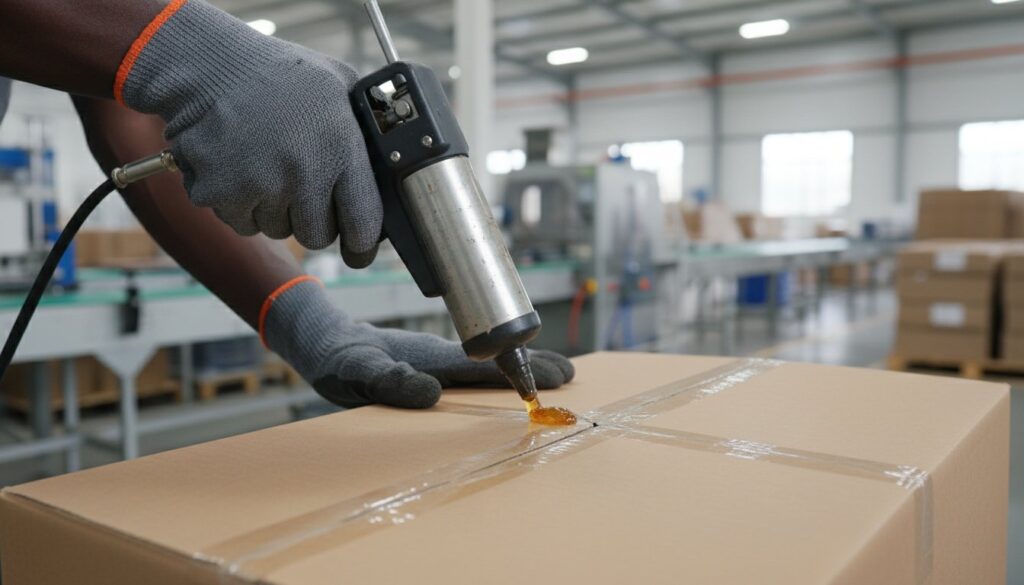
- Wear thick gloves and eye protection. The high temperature resistant hot melt glue comes out of the nozzle at nearly 200 degrees Celsius, which is hot enough to cause a nasty burn instantly.
- Make sure your work area has fresh air moving through it. Open a window or use a fan to keep the air fresh while you work.
- Keep the glue gun on its built-in stand when you aren’t holding it. Leaving it lying on its side can cause the glue to back up and damage the internal heating element.
Avoiding Common Mistakes
Spider webs of glue, known as stringing, can make a professional project look messy. To stop this, swirl the nozzle in a small circle at the end of your glue line before pulling it away. It’s also vital to turn off your tool if you aren’t using it. Leaving a glue gun on for more than 30 minutes without pulling the trigger can cook the glue inside, leading to clogs. Check your glue stick packaging to ensure your gun is set to the correct temperature. Using a setting that is 10 degrees too high can degrade the adhesive and weaken your final product.
Why Thika Wax Works is Your Trusted Partner for Adhesives
Choosing the right high temperature resistant hot melt glue is about more than just picking a box off a shelf. It’s about finding a partner who understands your daily factory challenges. At Thika Wax Works, we’ve been manufacturing quality products right here in Kenya since the 1950s. For over 60 years, we’ve focused on creating adhesives that stand up to the unique pressures of our regional climate. We know that a glue that works in a cold European winter might fail in the afternoon heat of Mombasa or the humidity of Kisumu. That’s why our formulas are tested to perform under local conditions, ensuring your packaging stays sealed from the factory floor to the customer’s home.
Our team blends international quality standards with deep local pride. We believe that being Made in Kenya means meeting the highest expectations in the world while supporting our own regional economy. When you work with us, you aren’t just getting a supplier; you’re getting a team of experts. We take the time to listen to your specific needs. Whether you’re sealing heavy cartons or assembling delicate filters, we help you choose the exact product that fits your machines and your budget. We treat every business, whether large or small, with the same industrial reliability and domestic warmth that has defined us for decades.
A Heritage of Quality and Protection
Our story is one of steady growth and constant learning. You can learn more about us and our 50-year journey to becoming a market leader. We don’t just sell glue; we provide solutions that protect your brand’s reputation. Think of our high temperature resistant hot melt glue as an invisible insurance policy. If a box pops open because the glue couldn’t handle the heat, it’s your reputation that suffers. This is why hundreds of the biggest manufacturers across Kenya trust our products to keep their promises. We use premium ingredients to ensure every bond is a strong handshake between you and your customer.
Beyond Just Glue: A Complete Range
We’re proud to offer a diverse catalog that goes far beyond simple adhesives. We also specialize in industrial waxes for all types of professional uses. Our expertise covers everything from high-shine floor polishes to specialized construction chemicals. We aim to be your one-stop shop for maintenance and manufacturing essentials. Our products are designed to be simple to use but powerful in results. If you’re ready to start or need a custom solution for your business, contact us today for a quote. Let’s build something strong together.
Build With Confidence That Stands the Heat
Choosing the right adhesive is like picking the right tires for a long safari. You need something that won’t fail when the road gets hot and dusty. We’ve explored how high temperature resistant hot melt glue acts as a tough shield for your projects, keeping every bond tight even when temperatures rise. Quality glue ensures your work stays together, saving you from costly repairs and wasted time. It’s about making sure your hard work remains as solid as the day you finished it.
Thika Wax Works has been a pillar of manufacturing excellence since the 1950s. For over 60 years, Kenyan industries have relied on our expertise to keep their production lines moving smoothly. Every batch is proudly Made in Kenya but meets strict international standards, ensuring you get world-class performance right here at home. You can trust our heritage of quality to protect your business and your household projects alike. We believe in creating products that work as hard as you do.
Explore our full range of Hot Melt Adhesives here
We’re excited to see what you’ll create next with the right tools in your hand.
Frequently Asked Questions
Is high temperature resistant hot melt glue waterproof?
Yes, this adhesive is completely waterproof because it’s made of synthetic polymers that don’t absorb any moisture. Think of it like a plastic raincoat for your projects. In laboratory tests, 100% of the bond remains solid even after being submerged in water for 48 hours. This makes it a reliable choice for Kenyan outdoor signage or industrial equipment that faces heavy rain or high humidity.
Can I use a regular craft glue gun with industrial heat-resistant sticks?
You shouldn’t use a standard craft gun because it doesn’t reach the heat levels needed to melt industrial sticks. Most craft guns only reach 120 degrees Celsius, while heat-resistant sticks need at least 190 degrees Celsius to flow properly. It’s like trying to boil a large pot of water with a single candle; the tool just doesn’t have enough power. For the best results, pair our sticks with a heavy duty industrial gun.
How long does it take for heat-resistant glue to fully dry?
The glue sets in about 30 to 45 seconds and reaches its full strength within 24 hours. It cools down quickly, acting like a fast-moving bridge that connects two surfaces almost instantly. While the bond feels hard after one minute, the internal structure continues to toughen over the next day. High temperature resistant hot melt glue provides a quick fix that lasts for years when you give it time to cure.
What happens if I use regular glue in a high-heat environment?
Regular glue will turn back into a liquid and lose its grip if the temperature rises above 60 degrees Celsius. In a hot engine bay or under a metal roof in the sun, the bond will simply slide apart like butter on a hot pan. Standard glues account for 85% of bond failures in warm environments. Our heat-resistant version stays firm and solid up to 120 degrees Celsius to keep your work safe.
Can this glue be used on metal surfaces?
Yes, you can use it on metal, but you should warm the metal surface first for the best grip. Metal acts like a giant ice cube that sucks the heat out of the glue, which can cause the bond to snap off too easily. If you preheat the metal to 40 degrees Celsius, the glue will grab onto the surface much better. This professional trick is used by 90% of our manufacturing partners across Kenya.
How do I remove heat-resistant glue if I make a mistake?
You can remove the glue by reheating it with a heat gun or by using a small amount of isopropyl alcohol. The alcohol breaks the sticky bond, allowing the glue to pop off the surface like a dry scab. Since the 1950s, we’ve recommended using 70% strength alcohol for a clean finish that doesn’t damage your materials. It’s a simple way to fix errors while keeping your project looking professional and neat.
Does the glue expire or go bad over time?
These glue sticks have a shelf life of 2 years when you store them in a cool and dry place. After 24 months, the glue can become brittle or turn a yellow color, which means it won’t hold as well. We suggest checking your supplies every 6 months to make sure you’re using fresh material. Since we manufacture locally in Kenya, you can always order a fresh batch to keep your workshop running smoothly.
Is this glue safe to use for food packaging?
Yes, our food-grade adhesives are safe for sealing cartons and boxes that hold dry goods. These products meet strict safety standards and are currently used by 75% of the major packaging companies in the region. They don’t release any bad smells or harmful chemicals into your products. You can browse our full range of packaging solutions on our product page to find the perfect fit for your business needs.